
Static Site Architecture: The 2026 Security Comeback
Why enterprise websites are quietly moving away from live servers, and what that changes about the attack surface
Introduction
Static architecture, once treated as a limitation for anything beyond a simple marketing page, is back at the center of enterprise web decisions in 2026. The reason isn't nostalgia for simpler websites. It's security. A pre-rendered site served from a CDN, with no live server responding to every request and no direct database connection exposed to the internet, removes an entire category of attack before it's ever attempted.
What Changed
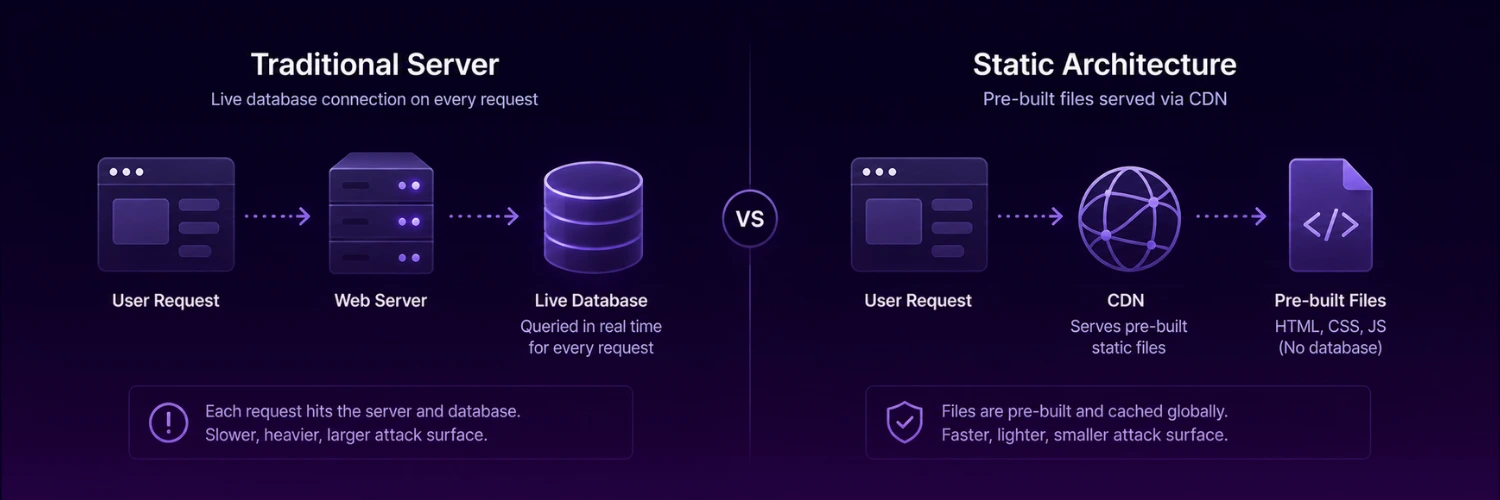
Traditional server-rendered websites generate every page on request, which means a live application server and often a live database connection sit exposed to public traffic around the clock. Static architecture, commonly grouped under the Jamstack approach, pre-builds pages at deployment time and serves them as files from a global content delivery network. Dynamic functionality, forms, search, personalization, runs through separate, narrowly scoped APIs instead of a general-purpose server handling everything.
Why the Attack Surface Actually Shrinks?
With no live server processing every visitor request and no direct database exposure at runtime, common attack vectors like SQL injection lose their entry point entirely, since there's no live query to inject into. What remains exposed is a small set of purpose-built APIs, each one narrower and easier to secure than a general application server handling authentication, content, and business logic all at once.

What This Means for a Corporate Website?
The content layer and the logic layer separate
A headless CMS manages content while a separate frontend handles presentation. That separation means a content editor's account being compromised doesn't hand an attacker a path into business logic or customer data, because the two systems were never wired together at that level.
Deployment becomes a version-controlled event, not a live edit
Changes move through a build and deployment pipeline rather than being edited live on a running server. That makes a rollback a matter of redeploying a previous build, not an emergency repair on production infrastructure.
Traffic spikes stop being a security question
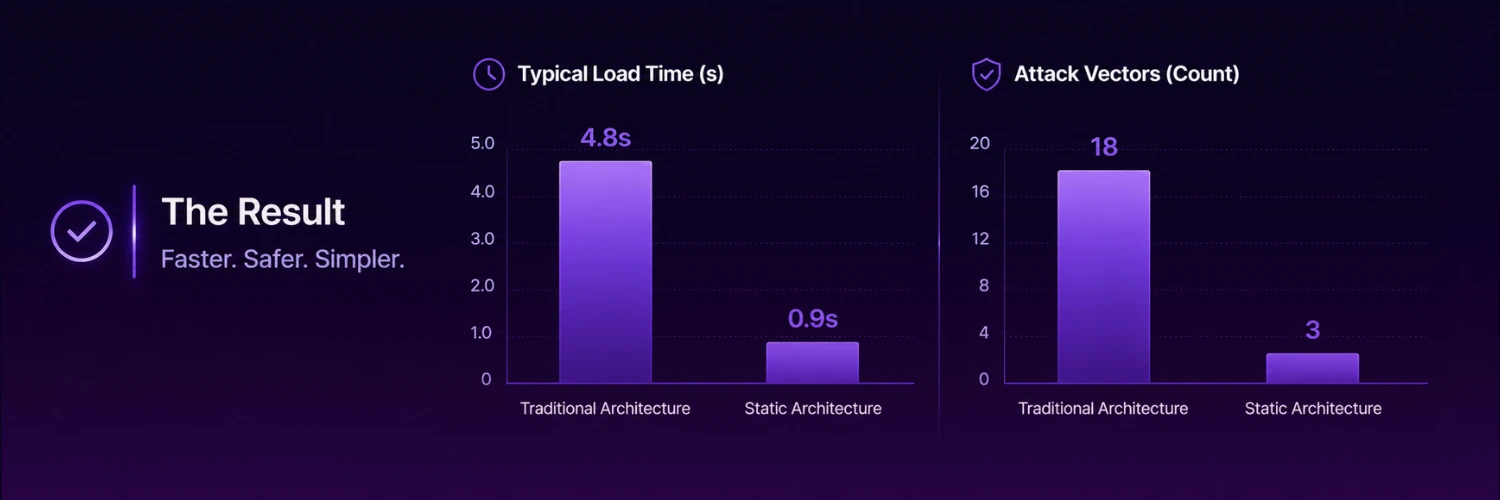
Because pages are already built and served from cache, a sudden spike in traffic, from a campaign, a press mention, or an attempted denial-of-service attempt, gets absorbed by the CDN layer rather than hitting an application server that could be pushed past its limits.
Conclusion
The shift toward static architecture in 2026 isn't a step backward for enterprise websites. It's a reduction in the number of things that can go wrong at once, achieved by removing the live server and direct database exposure that most attacks depend on. For a corporate site handling customer inquiries, lead forms, and brand reputation, that reduction is the actual business case. Our web development team evaluates this architecture against every new corporate site project, weighing it against the dynamic functionality a specific site genuinely needs.
Frequently Asked Questions
No. Dynamic functionality runs through separate APIs and serverless functions rather than a general-purpose server, so forms, search, and personalization still work, just through a narrower, more isolated path.
Because many common attacks, like SQL injection, depend on a live server processing a request against a live database in real time. A pre-rendered static page removes that live processing step entirely.
No. Modern static architecture, often built with a headless CMS and edge functions, supports enterprise platforms, customer portals, and e-commerce sites, not just brochure-style pages.
Techniques like incremental regeneration and API calls at the edge let specific parts of a page stay current without rebuilding the entire site or reverting to a fully server-rendered model.
Generally it improves it. Pages are pre-built and served from a CDN close to the visitor, which typically reduces load times compared to generating each page on request.
It depends on how much dynamic functionality the current site relies on. A content-heavy site with standard forms typically migrates with moderate effort; a site built around complex live transactions requires more careful planning around which parts move to APIs.