
AI does not upgrade an ERP. It reveals whether the ERP was built to be upgraded.This is the operational reality that most enterprise transformation programmes are not yet confronting directly. The conversation around AI in enterprise systems focuses heavily on capability, what can be automated, how fast decisions can be processed, which workflows can run without human review. That framing is appropriate for technology vendors. It is less useful for a CIO or COO who needs to know what to do with the system architecture they are currently running.The more productive frame is architectural readiness. The three shifts reshaping enterprise ERP in 2026 do not describe a world where AI is added to existing systems. They describe a world where effective AI execution, regulatory compliance, and commercial competitiveness require ERP systems that were designed with specific structural properties, properties that most deployments in the GCC do not currently have.
Shift One: AI Execution Will Live Inside the ERP, and the ERP Must Be Ready for It
The AI adoption pattern that is now emerging in enterprise environments is not the one that was anticipated two years ago. The expectation was that AI tools would sit alongside enterprise systems, a layer of intelligence applied to data that was extracted, processed, and returned. What is actually happening is different. AI agents are being embedded inside enterprise applications, operating directly within the workflows, data models, and logic layers of the ERP itself.
This distinction matters enormously for architecture. An AI agent operating inside a procurement workflow is not reading a report, it is writing to the ERP's transaction layer. An agent handling invoice processing is not summarising data, it is executing against the ERP's tax classification framework. An agent assisting with financial close is not recommending actions, it is committing records.
For this to produce reliable outputs, the ERP's data model must be consistent. Tax classifications must be unambiguous across all legal entities. Approval logic must be machine-readable. There must be no reconciliation gaps between modules that require human correction before data can be trusted.
Across the enterprise deployments we work with in the UAE, the most common architectural pattern is the opposite of this. Data models that were extended incrementally to meet compliance requirements without a unified redesign. Tax classification logic that varies between business units. Manual reconciliation steps that exist because two system modules do not produce consistent outputs without human intervention.
An AI agent embedded in a system with these properties does not resolve the inconsistencies. It executes against them, producing outputs that appear automated but are structurally unreliable, and that create compliance exposure precisely because they bypassed the human review that was previously compensating for the architecture's gaps.
The action this shift demands is not AI procurement. It is a data integrity audit, a systematic assessment of which parts of the ERP's data structure are clean enough to support autonomous execution, and which require architectural correction before any AI capability is introduced.
Cloud ERP platforms with embedded AI functionality offer genuine operational advantages. But realising those advantages requires CFOs and CIOs to navigate the gap between vendor capability and organisational readiness, and that gap is almost always architectural, not technical.
For organisations evaluating their current ERP against this standard, Odoo ERP consulting in the UAE context begins with exactly this assessment: a structural readiness review before any capability investment is made.
Shift Two: Data Sovereignty Is No Longer a Future Consideration
For the past several years, data sovereignty, the question of where enterprise data is processed, stored, and governed, has been treated in the UAE as a forward planning concern. Organisations acknowledged it as a trend, noted it in risk registers, and deferred the architectural decisions it implied.
That deferral window is closing.
The UAE's e-invoicing mandate requires on-shore storage of invoice records and audit trails. The FTA's audit access requirements demand that financial data be retrievable on demand from within UAE jurisdiction. The broader digital sovereignty agenda, actively legislated across the UAE and the GCC, is producing a regulatory environment in which the location of enterprise data is a compliance variable, not an infrastructure preference.
What this means in practice for ERP architecture: an ERP hosted on global public cloud infrastructure with data processed outside the UAE carries compliance risk that is currently manageable but is becoming structurally untenable as the regulatory framework matures. Organisations that have not mapped their current deployment architecture against UAE data residency requirements, current and projected, are carrying unquantified risk that will become quantified at the next audit cycle or regulatory update.
The geopatriation decision, migrating workloads from global public cloud to sovereign, regional, or UAE-hosted infrastructure. is not a binary technology choice. It is an architectural decision that requires evaluating the ERP's current deployment model against a forward-looking compliance map.
Specifically: the ERP must be capable of operating on UAE-sovereign infrastructure without degradation in functionality, integration performance, or regulatory output quality. This rules out deployment approaches where the system's core processing relies on infrastructure outside UAE jurisdiction, or where sovereign deployment would require a full platform migration with no controlled transition path.
The enterprises that manage this transition well are those that made the deployment architecture decision with data residency in view from the start. For those that did not, the question is how to close the gap without disrupting operational continuity. a sequenced migration plan, not a crisis remediation.
Cloud hosting architecture for UAE enterprises must now be evaluated against sovereign compliance requirements as a primary criterion. not an afterthought to performance and cost optimisation.
Shift Three: B2B Commerce Is Moving to API-First, and the ERP Must Keep Up
The commercial environment for B2B enterprises in the UAE is changing at the integration layer. Procurement processes that were previously managed through human-to-human negotiation, manual order placement, and email-based confirmation are being replaced, progressively, across industries, by API-driven exchanges where systems communicate directly, transactions execute automatically, and accuracy is verified at the data level.
This shift is not driven by any single technology or platform. It is the cumulative effect of ERP maturity across buyer organisations, the adoption of structured procurement platforms, and the commercial pressure to reduce the cost and error rate of manual transaction processing.
For a supplier organisation, the architectural consequence is concrete. The ERP's external-facing integration layer is no longer a technical convenience for internal data exchange. It is the commercial interface through which the organisation participates in an increasingly automated market.
An ERP that cannot return accurate, real-time pricing and inventory data to an external system query, because its integration layer was built for batch synchronisation, creates friction in procurement relationships that buyers will eventually route around. An ERP whose invoice data requires manual extraction and reformatting before it can be submitted to a buyer's procurement system is a constraint on commercial velocity, not just an operational inefficiency.
In the UAE's B2B context, this shift intersects directly with the e-invoicing mandate. Organisations that build the API connectivity required for FTA-compliant invoice transmission are, simultaneously, building the integration foundation for API-driven commercial exchange. These are not separate programmes. The same architectural layer supports both.
The enterprises that are well-positioned for this shift are those whose ERP integration architecture was designed for machine-to-machine exchange from the start, structured data models, live API endpoints, and integration logic built to serve external systems as reliably as internal ones. This is precisely what integrated API solutions must deliver in the current enterprise environment: not connectors between existing systems, but a structured data interface through which the enterprise operates in a market that is increasingly automated at the transaction layer.
The Pattern These Three Shifts Share
Each of the three shifts described above places a structural demand on the ERP. Not a feature demand, a structural one.
AI execution readiness requires a clean, consistent data model across all legal entities, with compliance logic embedded at the transaction layer and no manual reconciliation steps that an automated process cannot handle. Sovereign cloud compliance requires a deployment architecture that was designed with data residency as a constraint, not a preference. API-driven commerce requires an integration layer built for real-time, structured exchange with external systems.
What makes these three demands significant, taken together, is that they converge on the same architectural foundation. The ERP that is ready for AI execution is the same ERP that is ready for sovereign deployment. The integration layer that supports API-driven commerce is the same layer that connects to FTA-accredited service providers for e-invoicing. These are not parallel investments. They are the same investment in architectural integrity — made once, correctly, with the full requirements landscape in view.
Across our work with multi-entity enterprises in the UAE, the organisations that navigate these shifts most effectively share a common characteristic: they treated ERP architecture as a strategic decision, not a procurement event. They invested in data model consistency before they needed it for AI. They made deployment decisions with compliance in view before regulators required it. They built integration layers for future exchange requirements, not just current ones.
The gap between that posture and the more common one, ERP as a configured platform, extended incrementally to meet each new requirement as it arrives — is the gap that 2026 is making visible.
This connects directly to multi-entity process design and execution complexity: the architectural foundation that these three shifts require is the same foundation that operational performance across multiple legal entities requires. The investment addresses both.
A Diagnostic Frame for CIOs and COOs
These three shifts become actionable when translated into specific questions about the current state of the enterprise system architecture.
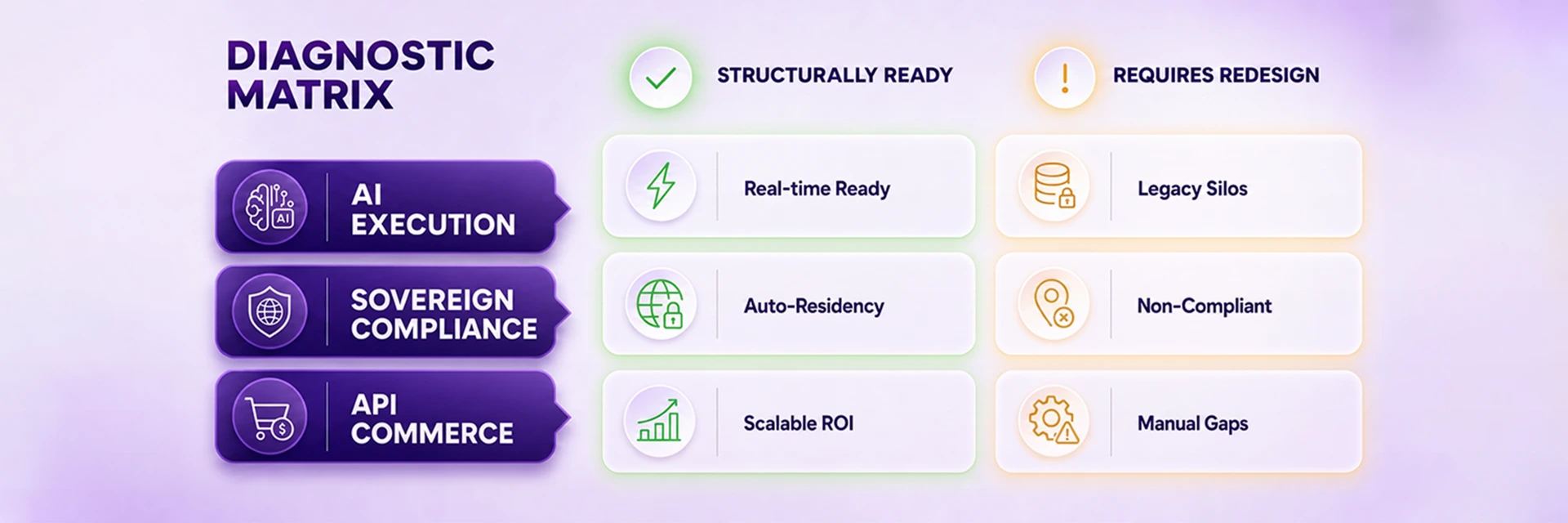
On AI execution readiness: Are the ERP's data models consistent across all legal entities, same field structures, same tax classifications, same validation logic? Are there manual reconciliation steps between system modules? If yes, the architecture requires correction before any AI capability is embedded. The diagnostic action is a data integrity audit.
On sovereign cloud compliance: Where is the ERP's data currently processed and stored? Does that align with UAE on-shore requirements for financial records, invoice archives, and audit trails? Has the deployment architecture been assessed against the current and projected UAE data residency framework? If not, the architecture is carrying compliance risk that will become explicit at the next regulatory update.
On API and integration readiness: Can the ERP return accurate, real-time pricing and inventory data to an external system query? Is the integration layer built for live exchange or batch synchronisation? Is the organisation's external data interface structured for machine-to-machine accuracy? If the answers are unclear, the integration architecture requires mapping before commercial automation advances further.
For organisations whose assessment reveals gaps across multiple areas, the priority sequence is consistent: data model integrity first, compliance architecture second, integration layer third. Each subsequent layer depends on the one before it. AI capability is introduced into a system that has been designed to support it.
This is what ERP consulting in the UAE context requires in 2026: an architectural readiness assessment as the starting point, before any decision about capability, platform, or tooling is made.
Frequently asked questions
Because AI agents embedded in ERP workflows execute against the data model they operate in. If that data model has inconsistencies, different tax logic across entities, reconciliation gaps between modules, manual corrections embedded in workflows, the AI agent produces unreliable outputs. The quality of AI execution is a direct function of the quality of the underlying architecture. This makes data model integrity a prerequisite for AI adoption, not a parallel workstream.
The FTA's e-invoicing mandate requires on-shore storage of invoice records and audit trails. As UAE data residency requirements continue to develop, ERP systems whose data is processed on global public cloud infrastructure outside UAE jurisdiction carry increasing compliance risk. The practical impact is a deployment architecture decision: the ERP must be capable of operating on UAE-sovereign infrastructure without loss of functionality or compliance output quality.
It changes the performance standard for the ERP's external integration layer from "can exchange data with other systems" to "can return accurate, real-time, structured data to external system queries on demand." Batch synchronisation and manual data exports do not meet this standard. The integration layer must be rebuilt for live, machine-to-machine exchange, which is the same architectural requirement that FTA-compliant e-invoice transmission imposes.
Data model integrity first, ensuring the ERP's core data structures are consistent and machine-readable. Compliance architecture second, aligning the deployment model with sovereign requirements and embedding regulatory logic at the transaction layer. Integration layer third, building the API architecture that supports both FTA connectivity and external commercial exchange. AI capability is introduced into this foundation, not before it is established.
Multi-entity organisations face each of these challenges at multiplied complexity. Data model consistency must be maintained across all legal entities. Sovereign cloud requirements may vary between mainland, free zone, and branch entities. API integration must route accurately to entity-specific configurations. The architectural investment that addresses all three shifts is the same investment that resolves multi-entity operational fragmentation, making it a single strategic programme, not three separate ones.
Strategic Takeaway: The Architectural Decision Is the AI Strategy
The instinct when confronted with these shifts is to ask what technology to procure. The more productive question is what in the current architecture is preventing the organisation from using new technology effectively and what needs to be redesigned before investment in capability compounds the gaps it was intended to close.
The three shifts described here are not a technology roadmap. They are a structural forcing function. The enterprises that navigate this period well are those that treat architectural readiness as the precondition for transformation not as a deferred workstream to be addressed once the tools are already deployed.
The gap between where most UAE enterprise ERP deployments currently sit and where these three shifts require them to be is an architectural gap. That is where the work is, and the organisations that begin it now will absorb it as a planned investment. Those that defer will absorb it as an operational crisis.
Related Insights
For further reading on how ERP architecture, compliance design, and operating model integrity intersect in UAE and GCC enterprise environments:
Industry-Specific ERP Systems: How UAE Regulations Shape Architecture
Tax Compliance Systems: How Regulations Reshape ERP Architecture