
The Sequencing Risk UAE Manufacturers Are Missing
A practical sequencing framework for manufacturers running Odoo 19 under the UAE's industrial expansion push
Introduction
Operation 300bn, the UAE's national industrial strategy, targets more than doubling the manufacturing sector's contribution to the national economy by 2031. That push is changing how manufacturers approach digital transformation: instead of implementing an ERP system first and layering AI capabilities on later, once the system has stabilized, many are deploying both at the same time. The pace is understandable given the policy pressure and funding behind it. The risk that comes with it gets far less attention.
The Trend Behind the Shift
Government-backed funding and streamlined approval processes have made it easier for manufacturers to bundle ERP implementation and AI capabilities like predictive maintenance and demand forecasting into a single project rather than two sequential ones. For a manufacturer under pressure to modernize quickly, that bundling looks efficient on paper: one procurement process, one implementation timeline, one vendor relationship to manage.
The Risk Nobody's Managing
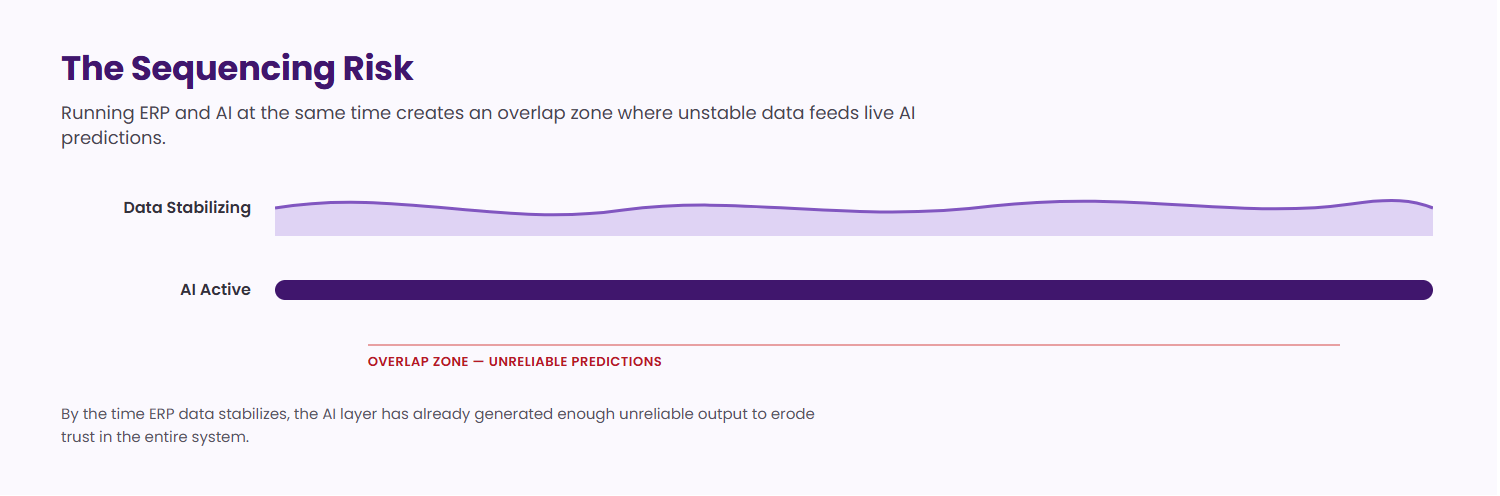
An AI model is only as reliable as the data feeding it, and during the first months of any ERP implementation, that data is rarely clean. Inventory counts are still being reconciled. Bills of materials are still being corrected. Machine downtime logs are still being standardized across shifts. Feeding a predictive maintenance model or a demand forecasting engine this data produces confident-looking outputs built on an unstable foundation, and by the time the ERP data stabilizes, the AI layer has already generated enough unreliable predictions to lose the floor team's trust in the entire system, ERP included.
A Sequencing Framework That Works
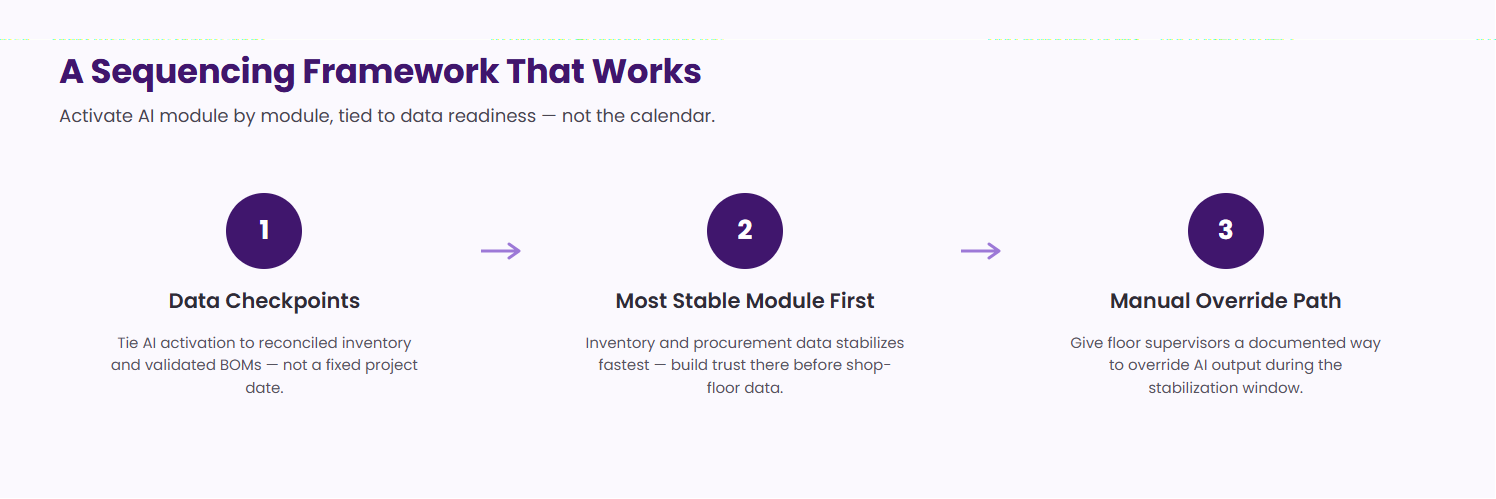
Activate AI on data-quality checkpoints, not calendar dates
Instead of switching on a forecasting or maintenance module at a fixed point in the project plan, tie activation to measurable data-quality thresholds, reconciled inventory counts, validated bills of materials, a defined minimum of clean historical data. The AI layer turns on when the data is ready, not when the calendar says it should be.
Start with the most stable module, not the most exciting one
Inventory and procurement data typically stabilizes faster than shop-floor and maintenance data. Activating AI capability there first builds a track record of reliable output before extending it to messier, higher-variance data sources.
Keep a manual override path during the stabilization window
Floor supervisors need a clear, documented way to override an AI-generated recommendation during the early months without treating every override as a system failure. That path is what keeps trust intact while the underlying data catches up to the model.
Conclusion
Operation 300bn's timeline creates real pressure to move fast, and moving fast on ERP and AI together isn't the mistake. Activating the AI layer before the data underneath it is ready is. Odoo 19's modular architecture supports enabling forecasting and maintenance capabilities module by module rather than all at once, which is what makes a sequencing framework like this practical to implement rather than theoretical. Our ERP consulting and Odoo custom development teams build this staged activation directly into manufacturing implementations on Odoo ERP.
Frequently asked questions
Operation 300bn is the UAE's national industrial strategy aimed at more than doubling the manufacturing sector's contribution to the national economy by 2031.
Because AI models trained on ERP data collected during the early, unstable phase of an implementation tend to produce unreliable outputs, which can undermine trust in both systems before either has had a chance to prove itself.
Not necessarily delay entirely, but sequence it: activate AI capabilities based on data-quality checkpoints rather than a fixed calendar date, starting with the most stable data sources first.
Inventory and procurement data generally reach reliable quality faster than shop-floor and maintenance data, making them a more suitable starting point for early AI activation.
Yes. Its modular architecture allows forecasting and maintenance capabilities to be enabled module by module rather than deployed all at once.
They should have a documented override path that lets them act on their own judgment without treating every override as a system failure, particularly during the data-stabilization period.