
Introduction
AI investment across UAE enterprises is rising sharply, and the ambition behind it is genuine: organizations here have moved faster than most regions on AI adoption. What doesn't always scale at the same pace is the return. When an AI investment underperforms, the instinct is usually to blame the tool, the model, or the vendor. In most cases, the actual bottleneck sits somewhere less visible: the data the AI is working with.
The Real Bottleneck Isn't the Model
An AI tool, however capable, can only act on the data it can actually see. When that data lives across a CRM, a set of spreadsheets, an ERP module nobody fully trusts, and a handful of disconnected tools, the AI ends up automating a fragmented process instead of fixing it. The output looks impressive in a demo and falls apart the moment it has to reconcile with the rest of the business.
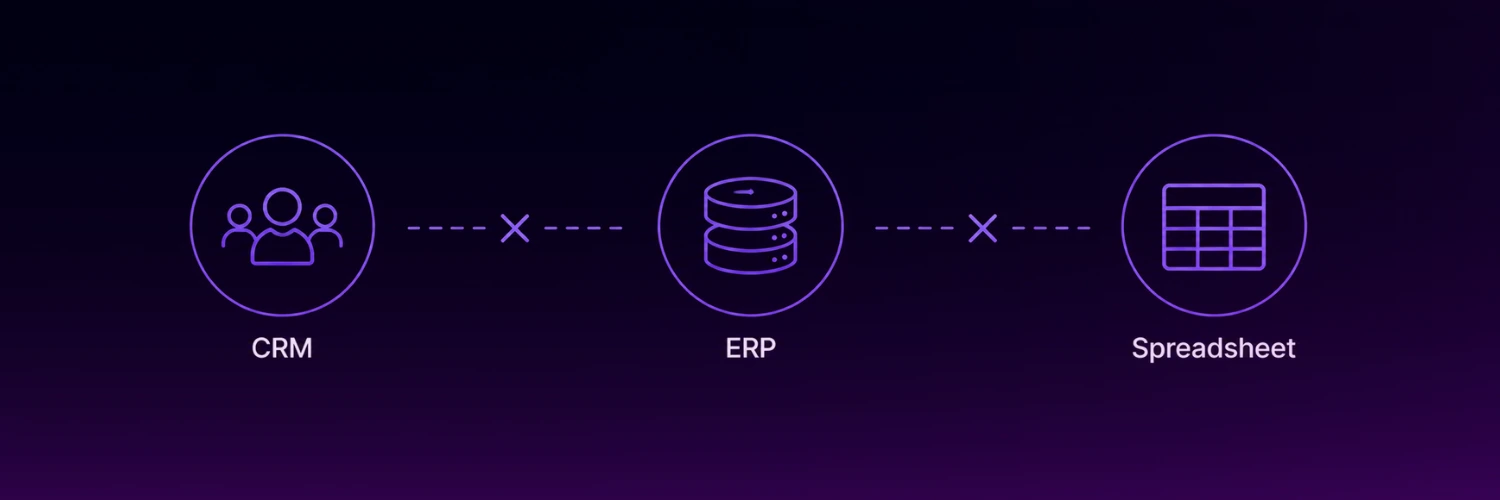
What Fragmentation Actually Looks Like
Duplicate records with no single owner
The same customer exists three times across three systems, each with slightly different details, and nothing forces them to reconcile. An AI tool built to personalize outreach or predict churn inherits that confusion silently.
Data that's accurate in one system and stale in another
A stock count updates in real time in the warehouse system but only syncs to the reporting layer once a day. Any AI decision built on the reporting layer is working from numbers that were already out of date when the model ran.
Manual exports standing in for integration
A spreadsheet gets pulled from one system and re-uploaded into another every week. It works, until someone forgets, formats it differently, or leaves the company, and the AI process built on top of it breaks without anyone noticing right away.
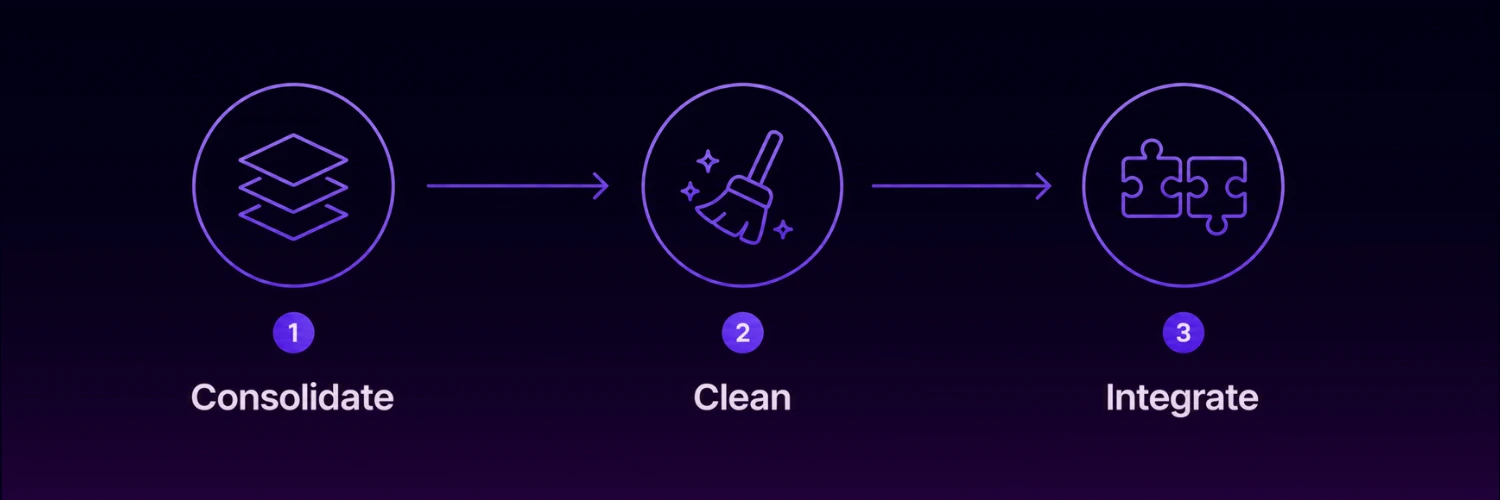
A Framework for Fixing the Foundation First
Consolidate the data layer before adding another tool
Before evaluating a new AI capability, identify which system is the actual source of truth for the data it needs, customer records, inventory, financials, and confirm every other system defers to it rather than maintaining its own version.
Fix data quality before automating decisions on top of it
Cleaning duplicate records, standardizing formats, and closing gaps in historical data is unglamorous work, but it determines whether an AI output is trustworthy or just confident-sounding.
Replace manual exports with a governed integration layer
Point-to-point exports and manual uploads are fragile by design. A proper integration layer keeps systems synchronized automatically and gives a clear, auditable path for how data actually moves.
Conclusion
The UAE's appetite for AI investment isn't the problem. The gap between that investment and its return usually traces back to the same root cause: an AI layer built on top of a fragmented data foundation. Fixing that foundation first, consolidating the source of truth, cleaning the data, and integrating systems properly, is what determines whether the next AI investment actually pays off or repeats the same pattern. Our ERP consulting and API and integration teams start every AI-readiness engagement at this layer, not with the model.
Frequently Asked Questions
Because the model can only act on the data it's given. If that data is fragmented, duplicated, or inconsistent across systems, the AI's output inherits those same problems.
Identify the actual source of truth for the data the tool will need, and confirm other systems are synchronized with it rather than maintaining separate, conflicting versions.
Both. The technical fix is proper integration; the process fix is agreeing on ownership, who is responsible for a given piece of data being correct.
It can assist with some data-quality tasks, but AI applied on top of unreliable data tends to produce confident, unreliable outputs. The foundation needs to be reasonably solid first.
It varies by how many systems are involved and how much manual process currently connects them, but starting with the single highest-impact data source is more effective than trying to fix everything at once.
It removes a major source of fragmentation when systems genuinely operate from one source of truth, but it still requires disciplined data governance and integration with whatever tools sit outside it.