
Your website is part of your ERP
Every time a customer submits an inquiry on your site, checks a price, places an order, or downloads an invoice, they are touching a business process. The question is not whether that interaction connects to your operations. It always does. The question is whether the connection is designed or improvised whether data flows automatically through a system architecture, or whether someone in your organization is copying it by hand.
For most enterprises operating across multiple entities, geographies, or business units, the answer is the latter. And that improvised connection is quietly one of the most expensive operational decisions the business has ever made.
The Structural Gap That Growth Creates
Enterprise web development has historically been treated as a design and content discipline. The website serves marketing objectives. The ERP serves operational ones. The two systems are maintained by different teams, procured on different timelines, and evaluated against different success metrics.
This separation makes sense at the early stage, when operational volume is low and the website is a brochure. It stops making sense the moment the website becomes a channel through which business actually flows when customers use it to enquire, order, verify status, or access documents.
At that point, the website is not a communication tool. It is an input surface for business transactions. And a transaction surface that is disconnected from the system of record produces a predictable set of problems: data entered on the website that must be re-entered into the ERP; inventory levels displayed on a web portal that do not reflect actual ERP stock; pricing shown to a customer that has already been superseded by a contract update in the system; customer accounts that exist in two places with different fields populated.
Over 87% of organisations report struggling with disconnected data sources that lead to operational inefficiency and fragmented decision-making. In multi-entity environments, that fragmentation multiplies: each entity may have its own ERP configuration, its own customer-facing interface, and its own reconciliation workflow. The cost accumulates silently in staff hours, in data errors, in customer experiences that expose the seams of a disconnected backend.
Digital Transformation Consulting: Why the Problem Is Architectural
The instinct when confronted with a disconnected web platform is to solve it at the integration layer to build a connector between the website and the ERP, synchronise the data, and declare the problem resolved. This works for simple, low-volume scenarios. It fails under the conditions that define scaled enterprise operations: high transaction volume, complex pricing logic, multi-entity entity structures, and regulatory reporting requirements.
The reason is that connectors and synchronisation tools treat the website and the ERP as two separate systems that need to talk to each other. They do not address the underlying architectural question: which system is the source of truth, and which system is the execution surface?
When a customer portal displays product availability, it should not be showing a value that was synchronised from the ERP six hours ago. It should be reading directly from the inventory record. When a web-submitted order is placed, it should not trigger a notification to a team who then manually creates the order in the ERP. It should create the ERP record directly, with the same validation logic that governs orders placed through any other channel.
This is the distinction between integration and architecture. Integration connects two systems. Architecture eliminates the boundary between them.
Organisations with experienced ERP-to-web architecture consistently achieve 99%+ order-to-cash accuracy with integrated platforms, compared to mid-90% performance from disconnected systems and that gap widens as volume and entity complexity increase. The difference is not the quality of the synchronisation tool. It is whether the web platform was designed as an extension of the ERP or as a parallel system.
The Execution Surface Model: What Web as ERP Extension Looks Like
Redesigning a web platform as an execution surface of the ERP requires a specific architectural approach one that changes the relationship between the frontend and the backend from "connected" to "continuous."
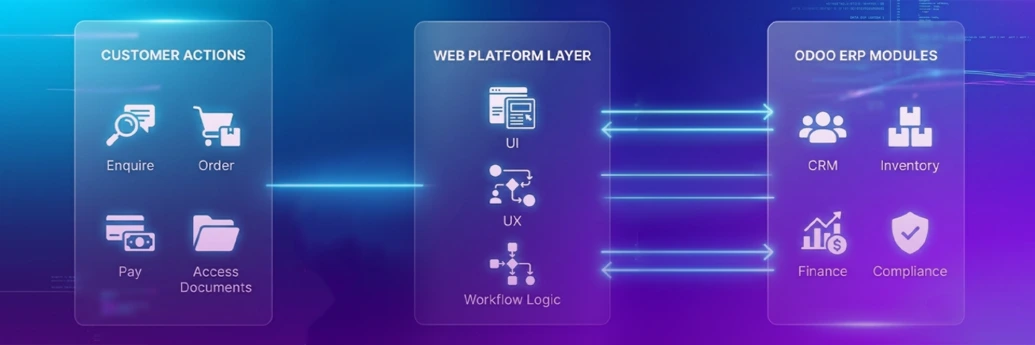
Real-Time Data Reads Replace Synchronized Snapshots
In a connected execution surface, the web platform does not hold its own copy of inventory, pricing, or customer account data. It reads from the ERP in real time, on request. This eliminates the errors that arise from synchronization lag. This requires API architecture built around live queries rather than batch exports. The ERP becomes the read-and-write source. The web layer handles presentation and user experience; the ERP handles data integrity and validation.
Web-Submitted Transactions Write Directly to ERP Records
Every form submission, order placement, or document request on the web platform should create or update an ERP record directly. This eliminates the manual re-entry that characterizes disconnected architectures. The ERP's controls approval workflows, credit limits, tax classifications apply to web-originated transactions automatically. A customer placing an order through the portal is subject to the same business rules as an internal sales team member.
The Customer-Facing Interface Reflects Operational Reality
The most visible sign of a disconnected web architecture is the gap between what a customer sees on a portal and what the business actually knows in its ERP. When the web platform is designed as an ERP execution surface, this gap closes. The customer portal becomes a read-only (and sometimes read-write) view of the customer's actual record in the ERP. The accuracy comes from the architecture, not from a content management effort.
Where the Bottleneck Actually Lives: A Diagnostic Pattern
In organisations where the web platform and ERP are disconnected, the bottleneck is rarely where it appears to be. The symptom delayed order processing, inaccurate portal data, repeated customer enquiries about order status is typically attributed to team capacity or process inefficiency. The root cause is data architecture.
A common pattern in multi-entity enterprise environments: a web platform receives B2B enquiries and order requests. The requests are received in the web CMS or an email inbox. A team member reviews the submission, checks it against the ERP, creates an ERP record manually, and then updates the web portal or replies to the customer. The total elapsed time from web submission to ERP record creation ranges from hours to days. The error rate from manual re-entry is non-trivial.
This is not a workload problem. The same volume of transactions, processed through a connected architecture, would require no manual re-entry, no cross-system checking, and no reconciliation step. The bottleneck is structural and it is invisible until the architecture is examined rather than the workflow.
The redesign follows a specific sequence. First, map every data exchange between the web platform and the ERP: what data the web currently reads from the ERP (or should), and what data web interactions should write to the ERP. Second, identify which exchanges are currently manual and what the volume and error rate of each is. Third, design the API layer that replaces each manual exchange with a direct, real-time connection. Fourth, align the web platform's data models with the ERP's ensuring that fields, classifications, and entity structures are consistent, not approximate.
Following this sequence in multi-entity enterprise environments, organisations consistently reduce order processing time by more than 40% and eliminate the category of errors introduced by manual data transfer entirely. More significantly, the ERP's data quality improves because web-originated data enters through the same validated pathways as internally originated data, rather than arriving as a manually entered approximation.
This architectural sequence is what distinguishes Odoo ERP custom development as a system design exercise rather than a configuration exercise: the web layer and the ERP layer are designed together, with shared data models and consistent execution logic, rather than being connected after the fact.
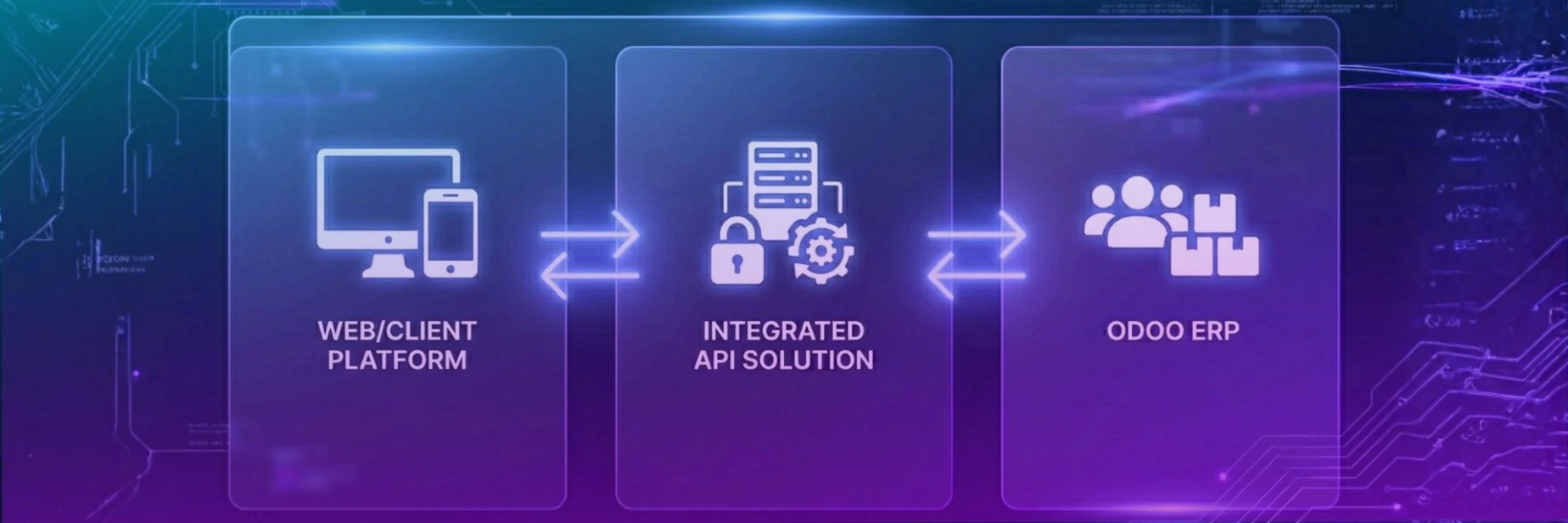
The Multi-Entity Dimension: Why Complexity Demands Architecture
For single-entity businesses with low web transaction volume, a disconnected web and ERP may be manageable. For multi-entity organisations multiple legal entities, multiple markets, shared or separate ERP instances it is not. The number of data exchange points multiplies with entity count. The risk of inconsistency compounds. And the customer experience across all touchpoints is only as consistent as the least integrated entity in the structure.
Multi-entity web architecture requires that the platform understands entity context at the point of interaction. A customer browsing from a specific entity's web presence, or logging into a portal under a specific account, should see pricing, product availability, and account data drawn from that entity's ERP configuration. This requires the web platform to carry entity logic, not just content logic.
The implication for architecture: the web platform must be designed with the multi-entity operating model in mind from the start. Retrofitting entity awareness into a web platform designed for a single entity is the equivalent of retrofitting compliance into an ERP that was configured without regulatory input possible, but structurally expensive and increasingly fragile.
This connects directly to how multi-entity process design and execution complexity demands a unified architectural foundation: data structures, process logic, and system interfaces must be consistent across entities even when operational execution varies between them.
Strategic Implications for CEOs and COOs
The framing of web development as a technology decision a question of platform, design agency, and feature scope obscures the strategic significance of the underlying architectural choice.
When a CEO or COO commissions a new website or a customer portal, they are making a decision about whether customer-facing transactions will enter the organisation's system of record automatically or manually. They are deciding whether the data the business uses to make decisions about inventory, demand, and customer behaviour will be accurate or approximate. They are determining whether the operational cost of running a web presence will decrease as volume grows, or increase proportionally with it.
These are not technology decisions. They are operating model decisions. And they are best made with the ERP architecture in view, not after the web platform has been designed and deployed.
Businesses using ERP systems consistently report measurable improvements across operational dimensions — 95% report process improvement after ERP implementation (Forbes, cited by Intuit, 2026), and organisations with integrated commerce and ERP platforms achieve order-to-cash accuracy that is structurally unattainable with disconnected systems. The web platform, when designed as an extension of the ERP rather than a parallel system, captures a share of these gains.
The strategic question is not whether to integrate the web platform and the ERP. It is whether to design that integration as an architectural layer from the start, or to accumulate the cost of disconnection over time and address it under increasing operational pressure.
For organisations evaluating their current web infrastructure against these criteria, the relevant starting point is web development scoped within the context of enterprise systems where the design brief includes the ERP data model, the API architecture, and the entity structure, not just the visual and content requirements.
Frequently asked questions
It means the web platform reads from and writes to ERP records directly, rather than holding its own data copy or requiring manual data transfer. The web interface is the presentation layer; the ERP is the data and logic layer. There is no synchronization gap.
Primarily because they were built at different times, by different teams, against different objectives. As the website became a transaction surface, the gap between them became operational risk but it is rarely diagnosed as an architecture problem until the cost becomes visible in staff hours and error rates.
In multi-entity organizations, each legal entity may have distinct pricing, tax treatments, and account structures. An ERP-integrated web platform can route each interaction to the correct entity context automatically, presenting the right data to the right customer without manual intervention.
Integration connects two separately designed systems through a data exchange layer. Architecture eliminates the boundary between them: the web platform is designed with the ERP data model in view, API connections are real-time, and the ERP handles all validation logic. Integration is a tactical fix; architecture is a structural design decision.
The most consistent improvements are: elimination of manual data re-entry, reduction in order processing time (typically 40%+), improvement in ERP data accuracy, and a sharp reduction in customer enquiries related to order status, as the portal reflects live ERP data.
Strategic Takeaway
The boundary between the web platform and the ERP is not a technical boundary. It is a design decision. Organisations that treat it as a natural separation accumulate operational cost proportionally with growth more transactions, more manual steps, more reconciliation, more errors. Organisations that eliminate the boundary through intentional architecture achieve the opposite: operational cost that declines as a proportion of volume, data accuracy that improves with scale, and a customer-facing interface that reflects rather than contradicts operational reality.
The website is part of the ERP. The question is whether that relationship is designed.
Related Insights
For further reading on how systems architecture, integration design, and operating model interact in enterprise environments: