
Why Approval Workflows Behave Like Queues, And Why That Matters
Every approval workflow in an enterprise is, in mathematical terms, a queue system. Work arrives (a request is submitted), a service resource processes it (an approver reviews it), and an output is released (approval granted or rejected). Queue theory “the mathematical discipline developed by Danish engineer Agner Krarup Erlang in 1909 and now foundational to operations research” provides precise tools for modeling how these systems behave under load.
The reason this matters to enterprise leaders is a property called non-linear delay accumulation. When a queue system approaches capacity when arrival rates approach service rates wait times do not increase gradually. They escalate exponentially. A system with variability and a series of processes with work-in-progress queues further aggravates delay, and pushing for high utilization rates in this situation with large batches of work produces a severe compounding slowdown. In approval workflows, this dynamic appears as a familiar symptom: the same approval request that took two days last year now takes ten, with no obvious change in individual effort or workload.
This is not a productivity problem. It is a systems design problem. And it requires a systems model to resolve.
How Growth Creates the Conditions for Structural Delay
The path from a functional approval process to a structurally broken one follows a recognisable pattern, one that is tightly correlated with organisational growth, not negligence.
In early-stage enterprises, approval flows are informal and fast. Volume is low, approvers have contextual familiarity with every request, and exceptions are the minority. The system operates well below capacity, and queue dynamics are benign.
As the business scales new entities, new geographies, new regulatory requirements, additional staff tiers the volume of approval requests grows. More critically, request complexity grows. Procurement approvals now carry regulatory classifications. Finance approvals span multiple legal entities with different tax treatments. HR approvals require multi-level sign-off under new governance policies.
A company's legal review process may delay the execution of high-value contracts, or a shortage of computing resources may slow progress on a new digital initiative. When leaders encounter a bottleneck, they may dedicate resources to addressing it only to find that the process in question is still stalled by other bottlenecks.
The underlying cause is that approvers the service resources in queue terms are being asked to process increasinglycomplex items at the same rate they handled simple ones. Utilisation rises. The queue loads. And because queue dynamics are non-linear, the delay compounds far faster than the volume increase that caused it.
Research indicates that 52.8% of business leaders believe long-term bottlenecks create the greatest impact on organisational growth, recurring constraints that create sustained operational challenges, not temporary disruptions. Approval workflows sit squarely in this category. They are not seasonal constraints. They are structural ones, embedded in how the organisation is designed to make decisions.
The Queue Theory Model: Three Variables That Explain Enterprise Approval Delay
Queue theory provides a precise analytical language for diagnosing approval delay. Three variables govern how an approval queue behaves, and understanding each is necessary before any intervention makes sense.
Arrival Rate (λ): How Work Enters the System
Arrival rate is the volume of approval requests entering the system per unit of time. In enterprise environments, this is not a stable variable. It is subject to seasonal spikes (financial year-end, budget cycles), regulatory triggers (new compliance requirements, audit periods), and organisational growth (new entities, new headcount, expanded vendor bases).
Most organisations design their approval capacity for average arrival rates, not peak ones. This means the system is structurally under-resourced for the conditions that matter most precisely when speed of decision-making has the highest strategic value.
Service Rate (μ): How Work is Processed
Service rate is how quickly an approver can process and close a request. In practice, service rate is not a function of individual speed, it is a function of decision complexity, information availability, contextual clarity, and the number of parallel approvals the approver is managing simultaneously.
When these factors degrade, when context is missing, information is fragmented across systems, or the approver is managing too many queues concurrently, service rate drops. And when arrival rate holds constant while service rate drops, the queue dynamics become severe very quickly.
This is the mechanism behind the pattern CEOs observe in fragmented multi-entity environments: decisions that appear straightforward are slow, and approvers report being busy without producing outcomes at the expected rate. The approver is not the problem. The decision environment the approver is operating in is the problem.
Server Utilisation (ρ = λ/μ): The Critical Ratio
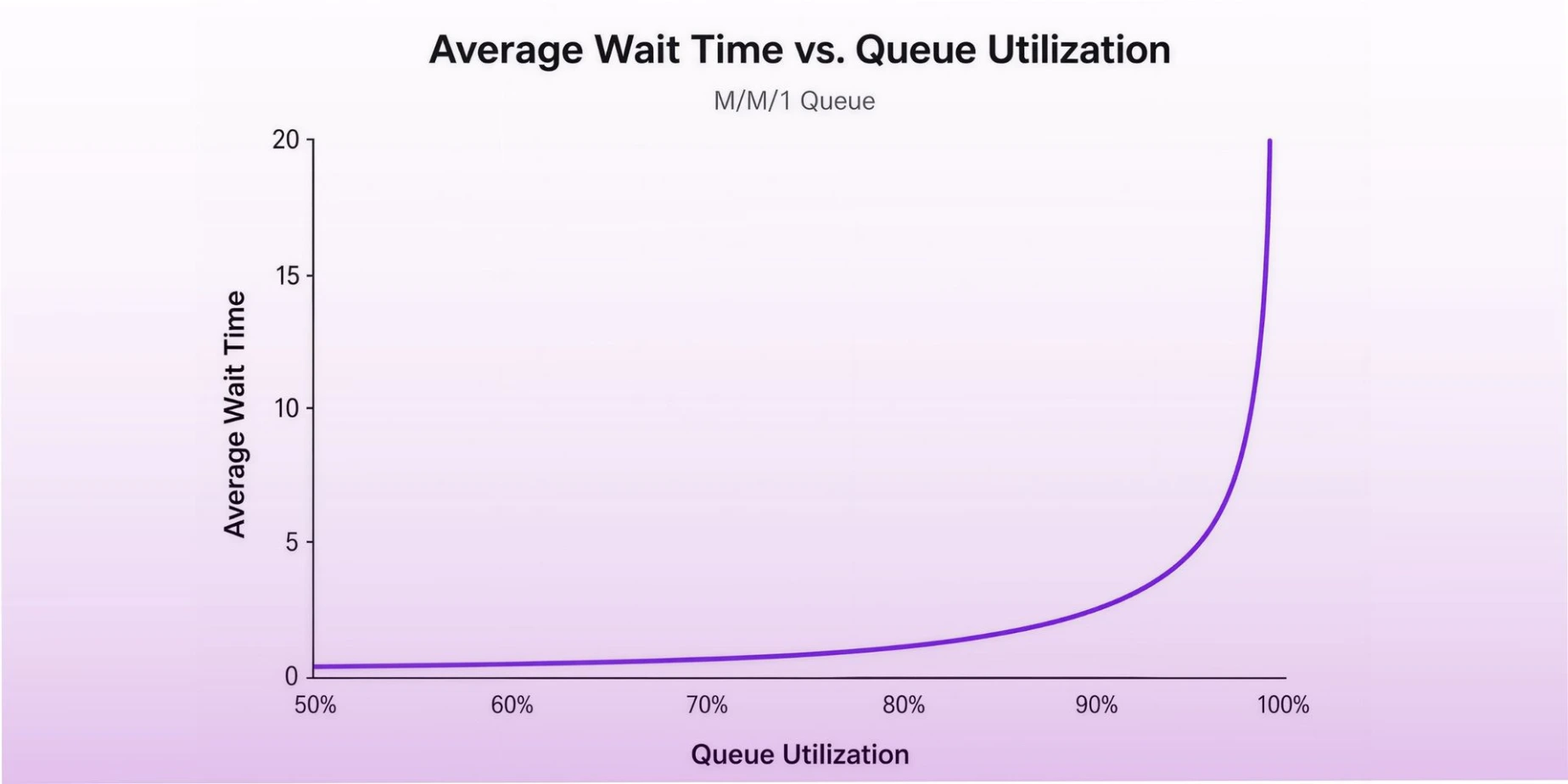
The utilisation ratio arrival rate divided by service rate, is the single most important variable in an approval queue. When ρ approaches 1.0 (full utilisation), average wait time approaches infinity. The mathematics of this relationship are not proportional; they are exponential.
Giving priority to certain tasks shortens their waiting time, but it does so at the expense of other work, usually causing a cascade of delay throughout the system. Queue theory reveals the structural cost of making exceptions, encouraging teams to regulate their application rather than treating urgency as a harmless override.
This is exactly the dynamic in overloaded approval systems. The urgent request is escalated and processed quickly. The backlog behind it deepens. The next escalation is triggered. The system is now operating entirely in exception mode which feels like a workload management problem but is actually a utilisation problem caused by a queue operating near capacity.
The Regional Context: The Meta-Enterprise Challenge
In the specific landscape of GCC Family Conglomerates and multi-entity groups across Dubai and Riyadh, these mathematical delays are often compounded by centralized governance models. In these 'Meta-Enterprises,' where a single corporate core manages diverse business units, the lack of digital synergy creates what we call a 'Super-Queue.' Without a decentralized framework that empowers entity-level decision-making, the head office becomes a permanent bottleneck, unintentionally stifling the very growth and diversification the region’s rise demands.
Where Delay Accumulates: The Multi-Stage Approval System
Single-stage queue analysis reveals the basic dynamics. The more consequential insight for enterprise executives is what happens in multi-stage approval systems which describes virtually every significant business process in a scaled organisation.
In a multi-stage system, each approval node is a queue in series. A purchase requisition moves from department head to finance to compliance to CFO. A contract moves from legal to commercial to executive sign-off. At each stage, the request joins a new queue, waits for service, and then proceeds to the next.
A model of a queueing system is developed by connecting single-resource models into a set of interconnected single-resource queueing models comprising a multiple-resource queueing network, and queueing theory can help organisations build efficient queues and optimise existing ones.
The critical property of multi-stage systems is that delay accumulates additively but variability compounds multiplicatively. A process with four approval stages, each operating at 70% utilisation, does not produce 70% of the delay a single stage would. It produces substantially more, because the variability in service time at each stage introduces uncertainty that propagates through every subsequent node.
In practical terms, this is why approval-to-execution timelines in scaled organisations are almost always longer than the sum of their parts, and why process mapping exercises consistently reveal that the actual work content of an approval represents a fraction of the total elapsed time.
This is the diagnostic insight queue theory provides: if elapsed time is many multiples of actual processing time, the system has a utilisation and variability problem at multiple queue nodes, not a workload problem that additional headcount will solve.
For organisations managing multi-entity operating structures, this compounding effect is particularly pronounced. Each legal entity introduces its own approval jurisdiction, each with its own arrival rate and service capacity, and the interfaces between them become queue nodes in their own right.
The Hidden Fragmentation Layer: When Approval Systems Evolve Without Design
The approval delays that concern CEOs and COOs most are rarely the ones that were always slow. They are the ones that were fast and became slow gradually, without a clear triggering event, and without an obvious person or policy to blame.
Queue theory explains this pattern through the concept of drift in utilisation ratio. As an organisation grows, arrival rate (λ) increases. If service rate (μ) is not scaled proportionally, because approver capacity, information availability, or decision frameworks are not redesigned utilisation creeps upward. A system that operated at 60% utilisation two years ago may now be operating at 85%, and the non-linear nature of queue dynamics means that the experienced delay at 85% is radically worse than at 60%.
Over 40% of finance professionals say automating purchasing and procurement processes is a top priority, yet only 4% of businesses have fully automated their workflows, and roughly 44% of procurement decision-makers cite efficiency and complexity as primary challenges for their procurement processes. The gap between prioritisation and execution is itself evidence of a system under load: organisations recognise the constraint but cannot free up the capacity to resolve it.
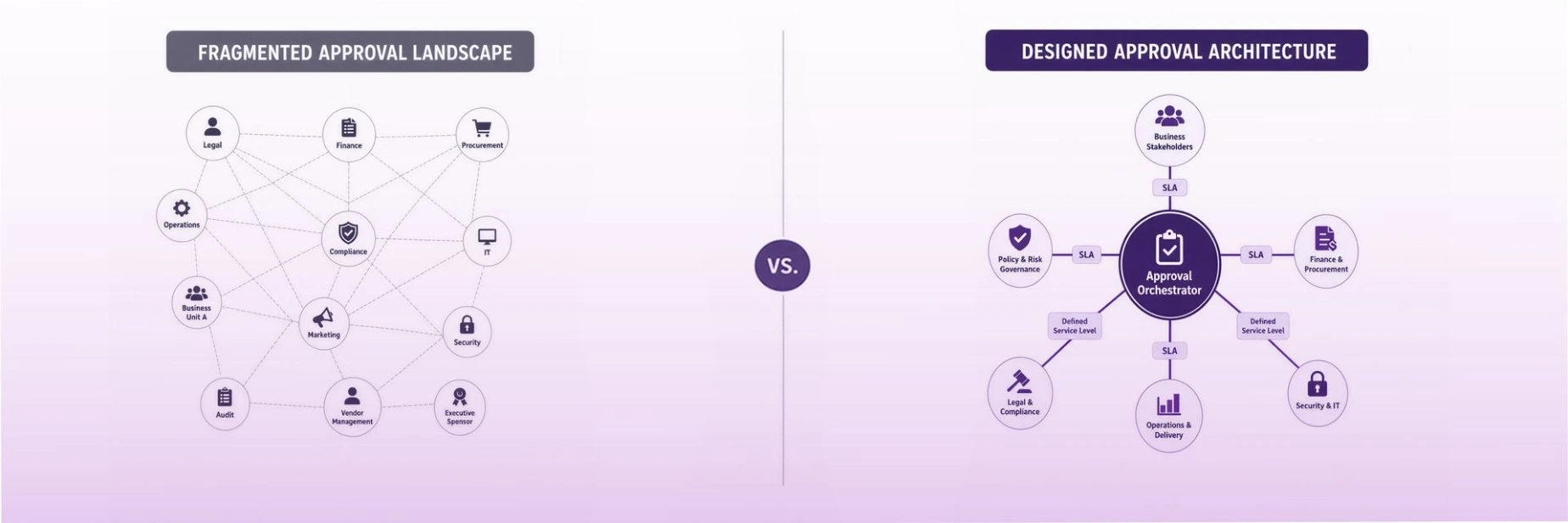
The deeper structural problem, however, is fragmentation, the accumulation of approval variants that developed as the organisation scaled. Different business units created parallel approval pathways. Regulatory requirements added layers that were never integrated into the core process design. ERP systems and manual processes run in parallel for different entity types. The result is an approval landscape that no single person in the organisation can fully map, and that exhibits the worst queue properties at every node.
This fragmentation pattern is directly connected to how technology alignment with operating model design determines whether systems support or obstruct execution at scale.
Redesigning for Queue Performance: Three Structural Interventions
The solution to structural approval delay is not faster approvers, more escalation pathways, or workflow automation applied to a broken underlying process. It is redesign of the queue system parameters: arrival rate management, service rate optimisation, and utilisation control.
1. Arrival Rate Management: Batch and Route Intelligently
Approval systems that process every request individually as it arrives maximise variability and, with it, delay. Structured batching, grouping requests of similar type, complexity, and approval jurisdiction into defined processing windows, reduces the variability term in the queue model and makes service rate more predictable.
More consequentially, intelligent routing ensures that requests reach the approver with the highest service rate for that request type. A CFO who spends approval time on requests that a department head could legitimately process is a misrouted queue, high-cost service capacity applied to low-complexity arrivals, while genuinely complex decisions wait in the same queue.
2. Service Rate Optimisation: Redesign the Decision Environment
Approvers are slow when the decision environment is poor. Missing information, ambiguous scope, unclear authority boundaries, and insufficient context all reduce effective service rate. The intervention is not training approvers, it is redesigning the information structure they receive with each request.
Specifically: approval requests should arrive pre-classified (type, risk level, regulatory classification), pre-contextualised (relevant history, comparable precedents, system-verified data), and pre-bounded (clear scope of what is being approved and what authority it invokes). This restructuring can reduce effective service time by 40–60% without any change to the approver population.
This is directly relevant to ERP system design in regulated environments: when the system presents information in a format that supports fast, confident decisions, service rate rises and the queue dynamics stabilise.
3. Utilisation Control: Establish Service Level Constraints
Strategy 1: Elevating Service Capacity Through Data Synergy
The common mistake in addressing delays is focusing solely on the individual's speed. In reality, the 'Service Rate' ($\mu$) is often throttled not by the person, but by Disconnected Systems. When a leader has to toggle between fragmented platforms to verify a budget, check inventory, or validate a contract, the cognitive load increases, and the decision-making velocity drops.
The solution lies in creating Strategic Synergy through a unified Data Dashboard. By integrating disparate operations into a single source of truth such as an intelligently configured ERP leaders gain immediate visibility. This synchronization transforms the approval process from a manual 'search and verify' task into a high-speed 'review and confirm' action, effectively doubling the system’s capacity without adding a single headcount."
The single most effective structural change in an overloaded approval system is establishing an explicit utilisation ceiling, a maximum number of open approval items per approver per review cycle, above which new arrivals are held, rerouted, or escalated to a parallel service node.
This is counter-intuitive to leaders accustomed to measuring approver output by throughput. But queue theory is unambiguous: operating a queue at 90% utilisation does not produce 90% performance. It produces near-breakdown performance, with severe delay accumulation and high variability in outcomes. Operating the same queue at 70% utilisation produces near-optimal performance with substantially lower average wait times.
The organisational implication is that the right number of approval items on a senior executive's desk is not the maximum their calendar allows. It is a controlled number that maintains decision quality and processing speed, which is ultimately more valuable to the business than the appearance of full utilisation.
Governance architecture is the mechanism through which utilisation ceilings are defined, enforced, and adjusted as the organisation scales.
A Diagnostic Framework for CEOs and COOs
Applying queue theory to approval workflows does not require a formal operations research engagement. It requires four measurements that most organisations can produce from existing system data.
Measure 1: Average arrival rate per approval type. How many requests of each category enter the approval system per week, and how does this vary across the year?
Measure 2: Average and variance of service time. How long does each approval type take to process once the approver begins active review? The variance figure is as important as the average, high variance is a signal of poor information structure.
Measure 3: Utilisation ratio by approver node. What proportion of available decision-making capacity is consumed by current arrival volumes? For most organisations, this calculation produces the first clear evidence of where the structural constraints are located.
Measure 4: Elapsed time versus processing time ratio. For each approval type, what is the ratio of total elapsed time (submission to decision) to actual processing time (time approver spent on the request)? Ratios above 5x indicate a queue with severe utilisation problems. Ratios above 10x indicate a system operating in near-breakdown conditions.
These four measurements produce a queue performance map, a diagnostic view of where the system is healthy, where it is under pressure, and where structural redesign is required. The output is not a project plan. It is a prioritised set of interventions, grounded in process modelling rather than executive intuition.
Strategic Insight: The Constraint Is in the Design, Not the People
The most consequential insight queue theory offers enterprise leaders is this: in an approval system operating near capacity, working harder produces marginal improvement. Redesigning the system produces structural improvement.
Organisations that treat approval delay as a motivation or accountability problem assign blame to the wrong variable and invest in interventions that do not move the underlying metrics. Organisations that treat approval delay as a queue performance problem measurable, modelable, and responsive to specific structural interventions achieve durable improvement in decision velocity without increasing headcount or executive load.
At the scale at which CEOs and COOs are operating, the speed of internal decision-making is not an administrative concern. It is a competitive variable. Organisations that can approve, initiate, and execute faster than their peers compound that advantage across every function. Those whose approval systems are silently operating in queue breakdown absorb that cost in delayed launches, frustrated high-performers, and missed windows none of which appear on a P&L but all of which constrain the velocity of the business.
The constraint is structural. The diagnosis is available. The intervention is designed.
Frequently Asked Questions
Queue theory is the mathematical study of waiting lines, systems where work arrives, waits for processing, and exits. In enterprise contexts, every approval workflow is a queue: requests arrive at a defined rate, approvers process them at a defined rate, and the ratio between the two determines how long requests wait. When arrival rate approaches processing capacity, delay accumulates non-linearly and small increases in load produce disproportionately large increases in wait time.
Because queue dynamics are non-linear. The relationship between system utilisation and average wait time is exponential, not proportional. A system loaded to 60% utilisation may have acceptable wait times. The same system at 85% utilisation, driven by a modest increase in request volume can produce wait times four to six times longer. This is why approval delays appear to deteriorate suddenly even when the underlying workload has grown gradually.
By measuring the ratio of elapsed time to active processing time at each stage in the approval chain. A stage where total elapsed time is five or more times the actual review time is operating with a significant queue backlog high utilisation, high variability, or both. Multi-stage processes should be mapped individually rather than analysed as a single workflow, as the constraint is almost always concentrated at one or two nodes.
Neither solves the structural problem in isolation. Automation applied to a poorly designed approval process accelerates a broken system. Additional approvers reduce utilisation temporarily but do not address the root causes of high service time: poor information structure, ambiguous authority boundaries, and misrouted request types. The effective intervention sequence is redesign first of the decision environment and routing logic followed by automation of the redesigned process.
Queue theory recommends that high-variability systems which includes most enterprise approval workflows, where request complexity varies significantly operate below 70–75% utilisation to maintain stable wait times. Above 80%, average wait times increase sharply. Above 90%, the system enters a near-breakdown regime where small fluctuations in arrival rate produce large and unpredictable delays. Most organisations that diagnose their approval systems for the first time discover utilisation ratios well above this range at their primary constraint nodes.
Related Insights
For further reading on how operating model design, system architecture, and governance interact in scaled enterprise environments: