
When Approval Logic Becomes the Constraint
In many organizations, delays in order cycles are attributed to workload, system limitations, or team capacity.
In practice, a more structural issue often exists:
Approval logic expands faster than execution needs.
As organizations scale, approval layers accumulate incrementally each introduced to address a specific risk, control requirement, or exception scenario. Over time, these layers are rarely removed.
The result is slower execution.
In one cross-industry case, a multi-entity organization experienced increasing delays in order processing despite stable demand and system performance. Orders moved through the system, but not through the business.
Cycle time expansion was caused by how decisions were structured.
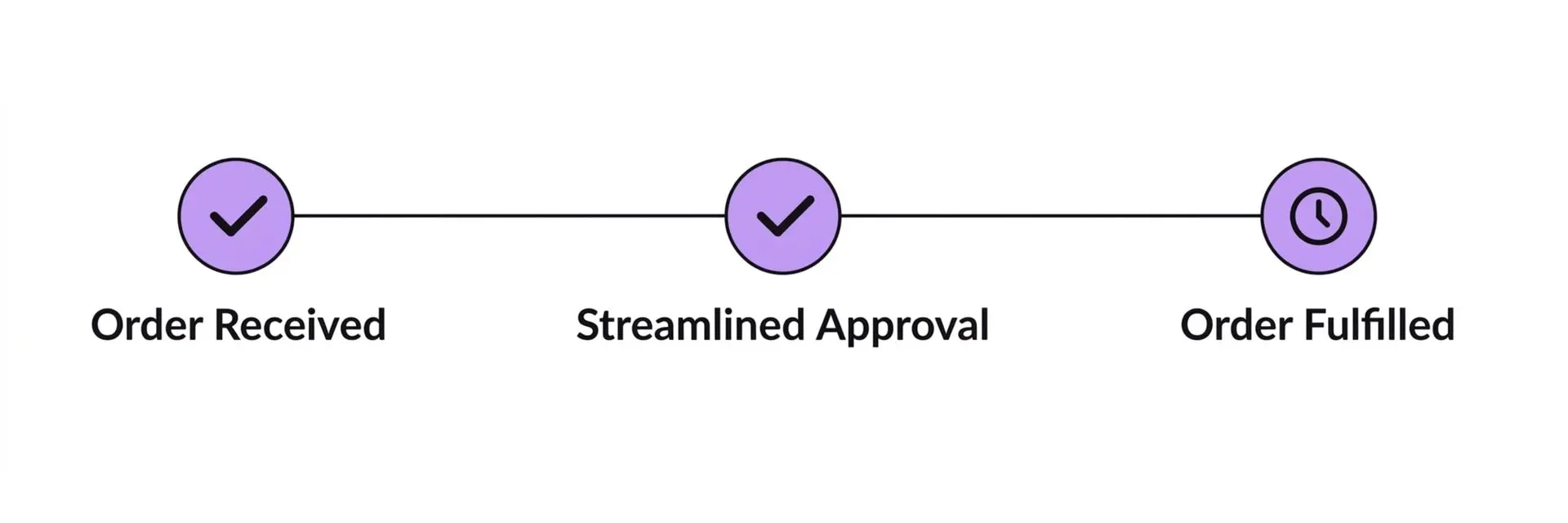
The Hidden Mechanics of Approval Delay
A detailed process trace revealed three structural issues within the approval architecture:
1. Sequential Decision Dependencies:
Approvals were structured in strict sequence, even when decisions were independent. Each additional step introduced cumulative latency rather than incremental control.
2. Misaligned Authority Levels:
Approval thresholds did not reflect actual risk exposure. Low-impact transactions triggered high-level approvals, creating unnecessary escalation loops.
3. System Enforced Redundancy:
ERP workflows enforced all approval steps uniformly, regardless of context. What was designed as control became systemic delay. The system was functioning as configured, & the configuration itself was the constraint.
Redesigning Approval Architecture, Not Just Processes
The intervention did not focus on accelerating approvals. It focused on restructuring how approval decisions are made and enforced.
Three targeted changes reshaped execution flow:
1. Parallelizing Independent Decisions
Approval steps were restructured based on dependency mapping. Where no direct dependency existed, approvals were executed in parallel rather than sequence. This reduced artificial waiting time embedded in the process.
2. Recalibrating Decision Thresholds
Approval authority was aligned with transaction risk and financial impact. Routine decisions were pushed closer to execution, while high-impact approvals remained controlled. This removed unnecessary escalation without weakening governance.
3. Context Aware Worklow Configuration
System workflows were redesigned to respond to transaction context. Instead of enforcing static approval chains, rules were condition-based triggering approvals only when required.This shifted the system from rigid enforcement to structured control.
Measurable Impact on Execution
The effect of redesigning approval architecture was immediate and structural:
- Order cycle time reduced by 32–38%
- Approval-related waiting time reduced by over 40%
- Decision throughput increased without additional resources
- Exception rates remained stable, indicating no loss of control
Most importantly, execution flow stabilized. The organization did not process orders faster because people worked harder.
It processed them faster because the system stopped forcing unnecessary decisions.

Why Approval Design Defines Operational Speed
Approval mechanisms are often treated as governance layers added on top of processes.
In reality, they are part of the process architecture itself.
Every approval introduces:
- a decision point
- a dependency
- a delay potential
At scale, these accumulate into a structural constraint.
Frameworks such as ISO 9001 emphasize controlled decision-making and traceability, but not at the expense of flow efficiency. The intent is disciplined execution, not decision congestion.
Related Insights
To explore how execution design, systems, and governance interact:
- Multi-Entity Process Design and Execution Complexity
- Technology Alignment with Operating Model Design
- Governance Sustains System Value in Enterprise Environments
- Execution Excellence and Decision Flow Design