
The Real ROI Is in the Training: Overcoming "Cultural Debt" in Enterprise Tech Adoption
Most enterprise technology investments are evaluated on licence cost, feature set, and implementation timeline. The variable that actually determines whether the investment pays off is training depth, and most organisations underfund it by a wide margin. The gap between a deployed system and an adopted one accumulates as cultural debt: unused features, workaround habits, and quiet resistance that compound every time a new tool lands on top of the last one nobody fully learned. This post sets out what cultural debt costs, why it forms, and the practical sequence that closes it.
A system that goes live and a system that gets used are two different outcomes, and most enterprise technology budgets only pay for the first one.
Across UAE and GCC enterprises, the pattern recurs with each technology cycle: an ERP rollout, a new CRM, an AI-assisted workflow tool. The procurement decision is rigorous. The training budget gets treated as a closing formality, a half-day session, a recorded walkthrough, a user guide nobody opens after week one.
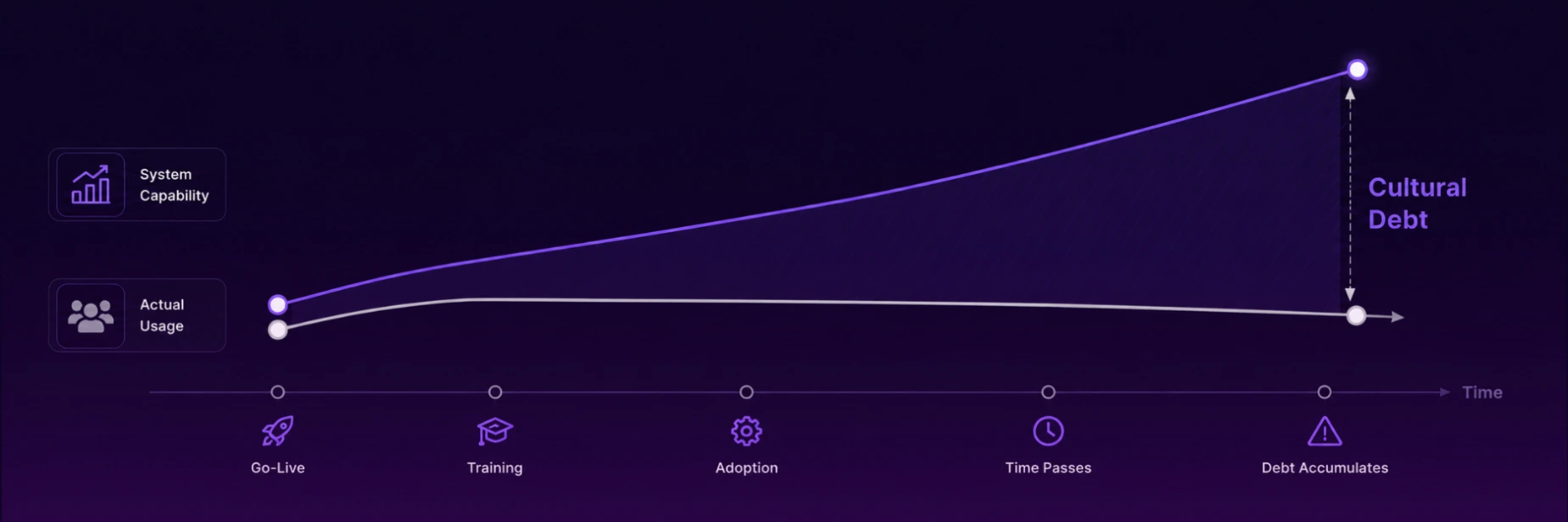
The result shows up months later as a gap between what the system can do and what the organisation actually does with it.
What Cultural Debt Actually Is
Cultural debt is the accumulated gap between the capability an organisation has paid for and the capability its people actually use, compounded with every subsequent technology investment. It behaves like financial debt: it does not disappear on its own, and the interest accrues.
This compounding effect is what separates cultural debt from a simple training shortfall. A single under-trained rollout is a one-time cost. Cultural debt is what happens when under-training becomes the organisational default across three or four technology cycles, and each new tool lands on a workforce that has learned, correctly, that adoption support will be thin and temporary.
Research into manufacturing digital transformation found that project failure rates reach 70%, with the primary failure factor identified as human and organisational instead of technological (Bellantuono et al., 2021). The technology, in most failed rollouts, worked as designed. The organisation around it did not absorb it.
The Numbers Behind the Resistance
Employee resistance to new technology is frequently framed as a motivation problem. The research points elsewhere. Workforce data finds that 37% of employees resist technology change, citing mistrust in leadership, lack of awareness, and fear of the unknown as the leading drivers (Apty.ai, 2026). Separately, 55% report that negative technology experiences directly affect their mood and morale, extending the cost of poor adoption into retention and engagement.
Despite widespread investment in digital tools, only 14% of organisations with active rollout plans report a digital adoption rate above 75% (Gartner, cited in Apty.ai, 2026). Most organisations have already bought the right technology. The distance between deployment and adoption is where they are losing.
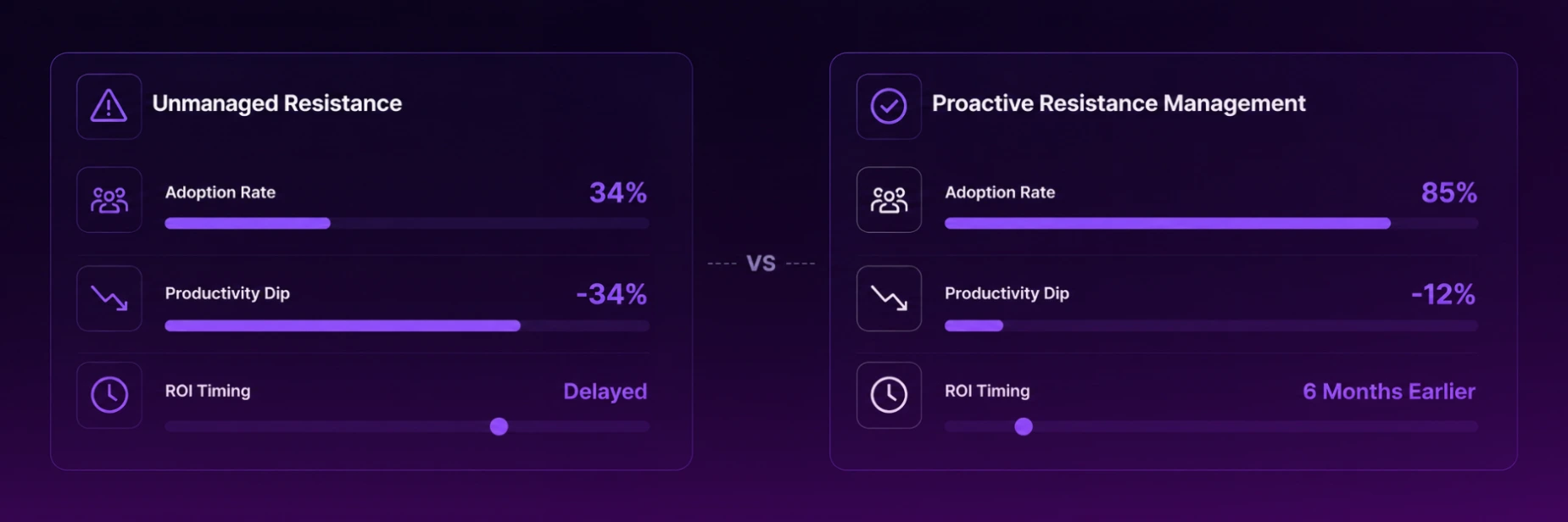
Proactively managed resistance produces measurably different outcomes from resistance left to run its course. Comparative research found technology adoption rates reach 85% with proactive resistance management, against 34% where resistance is left unmanaged. Productivity dips during transition average 12% under proactive management, against 34% without it, and ROI realisation arrives roughly six months earlier in the well-managed cohort (Cimini et al., 2020).
Why Organisations Misdiagnose the Problem
The most common executive response to low adoption is to treat it as a tooling problem: the interface is unintuitive, the platform is too complex, the vendor's onboarding was inadequate. Sometimes this is accurate. More often, it misdiagnoses a structural shortfall in change management as a product shortfall.
Transformation budgets reflect this misdiagnosis directly. Organisations allocate, on average, only around 10% of transformation budgets to change management, even as cultural resistance is consistently identified as the dominant barrier to successful adoption (Integrate.io, 2026).
A second, related misdiagnosis treats training as a single event instead of a sustained capability. KPMG's research found that 37% of executives identify the failure to adapt the operating model itself as the primary hurdle to transformation, while 30% point to legacy systems and habits as a direct barrier to execution. Training delivered once, at go-live, addresses the tool. The operating model, and the legacy habits that re-assert themselves once initial enthusiasm fades, go unaddressed.
For CFOs, this reframes the ROI conversation. The licence fee and implementation cost are visible and easy to track. Cultural debt sits invisible on the same balance sheet, and it is frequently larger.
The Real ROI Calculation
A useful way to make cultural debt visible to a finance audience is to model it as a deferred liability instead of a sunk training cost. Every workflow that reverts to a manual workaround represents ongoing labour cost the new system was supposed to eliminate. Every unused feature represents licence fee paying for capability the organisation cannot draw on. Every employee who quietly avoids the new system represents a parallel system the organisation now maintains without budgeting for it.
None of this appears as a line item. It appears as a productivity figure that never quite reaches the business case projection, and a second re-training initiative a year later, billed as a new project instead of recognised as the cost of the first programme falling short.
The correction is training designed with the same rigour applied to the technical implementation: role-specific content instead of generic onboarding, reinforcement at defined intervals, and a feedback loop that surfaces stalling adoption before it hardens into permanent workaround behaviour. This is the same discipline ERP consulting and implementation work in the UAE applies on the technical side, extended deliberately to the human side, where the actual ROI is won or lost.
Organisations carrying cultural debt from a previous rollout are the least likely to absorb the next one well, the same dynamic explored in the cost patterns behind failed technology investments, where failures trace back to organisational readiness more often than to the technology itself.
A Practical Sequence for Closing the Gap
Closing cultural debt requires sequencing training as a parallel workstream to implementation, not a closing task after it.
Pre-rollout diagnostic work should map existing workaround habits and skill gaps before the new system arrives, so training addresses each team's actual starting point. Role-specific training paths should replace one-size-fits-all onboarding, a finance team's relationship with a new ERP module is structurally different from a warehouse team's.
Staged reinforcement at thirty, sixty, and ninety days after go-live catches the point where enthusiasm fades and workaround habits re-emerge, the window where most organisations stop investing in adoption support. Leadership visibility matters directly: in high-trust environments, the negative effect of resistance on acceptance is substantially weaker than in low-trust ones, meaning visible leadership engagement measurably softens resistance (Lines et al., 2005).
Frequently Asked Questions
Cultural debt is the accumulated gap between the capability an organisation has purchased through enterprise software and the capability its workforce actually uses, compounded across multiple technology cycles. It forms when training is treated as a one-time event instead of a sustained capability-building process.
The cost is largely invisible on a standard balance sheet, appearing instead as productivity that never reaches projected levels and parallel manual processes running alongside the new system. Unmanaged resistance produces a 34% adoption rate against 85% under proactive management, with a productivity dip nearly three times larger.
Transformation budgets allocate only around 10% to change management on average, even though cultural resistance is consistently the dominant barrier to adoption success. This mismatch is the structural reason cultural debt accumulates.
Training delivered as a single go-live session addresses how to operate the new tool. Closing cultural debt requires addressing the operating model and habits the tool is meant to replace, through role-specific content, staged reinforcement, and a feedback loop that catches stalling adoption early.
In high-trust environments, the negative relationship between employee resistance and technology acceptance is substantially weaker than in low-trust environments. Visible, consistent leadership engagement throughout a rollout measurably reduces resistance.
Advisory note: Statistics and research findings referenced in this post are drawn from publicly available 2026 industry research and peer-reviewed studies as cited throughout. Organisations should validate applicability to their specific operational context before setting training budgets or change management targets.
Strategic Takeaway: Budget the Training Like It Determines the ROI, Because It Does
The enterprise technology investments that deliver their projected return share a common pattern: training was resourced and sequenced with the same seriousness as the technical implementation. The investments that underdeliver share the opposite pattern, and the underperformance shows up everywhere except the line item that caused it.
Cultural debt is a real, measurable liability. It compounds with every rollout that skips proper reinforcement, and it remains one of the few costs in enterprise technology that is almost entirely avoidable with the right sequencing.