
What Are the Best ERP Software Options for Small Businesses in UAE?
The question small business owners in the UAE usually ask, which ERP software is best, leads to comparison tables and feature checklists. The more useful question is what criteria actually determine whether an ERP supports growth or constrains it. This post sets out that evaluation framework: compliance readiness, scalability without re-platforming, and total cost of ownership beyond the licence fee. Odoo satisfies these criteria for most UAE small businesses on architectural grounds, and the post also identifies the specific business profiles where it is not the right fit.
A small business in the UAE rarely fails because it picked the wrong ERP brand. It fails because it picked ERP software around the wrong criteria.
Searching "best ERP software for small business UAE" returns dozens of comparison articles, each ranking the same five or six platforms against a similar checklist of features: invoicing, inventory, CRM, reporting. These comparisons answer a narrow question what can this software do when the question that determines business outcomes is different: what will this software cost the organisation, structurally, as it scales, complies, and changes shape over the next five years?
This post sets out the evaluation criteria that matter for a small business operating in the UAE specifically, where VAT compliance, the e-invoicing mandate, and free zone or mainland licensing structures place requirements on business software that generic global comparisons rarely address. None of what follows depends on which specific ERP brand a business eventually selects. The criteria apply regardless of the shortlist, and they produce a more reliable decision than ranking platforms against a feature checklist that treats every small business as identical.
Why the Feature Checklist Approach Fails Small Businesses in the UAE
Most ERP comparison content is written for a generic global audience and then localised with a UAE label. The features compared invoicing, basic accounting, simple inventory tracking are table stakes. Nearly every ERP platform on the market handles them adequately. Differentiating ERP software on this basis produces a list where every option looks similar, because the comparison is measuring the wrong layer of the system.
The layer that actually determines outcomes for a small UAE business is compliance architecture. The UAE's VAT framework under Federal Decree-Law No. 8 of 2017 requires transaction-level tax classification and audit-ready record keeping. The e-invoicing mandate under Ministerial Decisions 243 and 244 of 2025 requires structured invoice generation in the PINT AE format, with phased deadlines extending to all VAT-registered businesses by 1 January 2027 which includes the majority of small businesses currently exempt from the large-enterprise threshold.
A small business that selects ERP software based on a feature checklist, without verifying that the platform's underlying architecture supports these compliance requirements natively, will discover the gap at the point of enforcement, when manual workarounds, third-party add-ons, or a forced platform migration become the only options. That discovery is expensive, time-pressured, and avoidable.
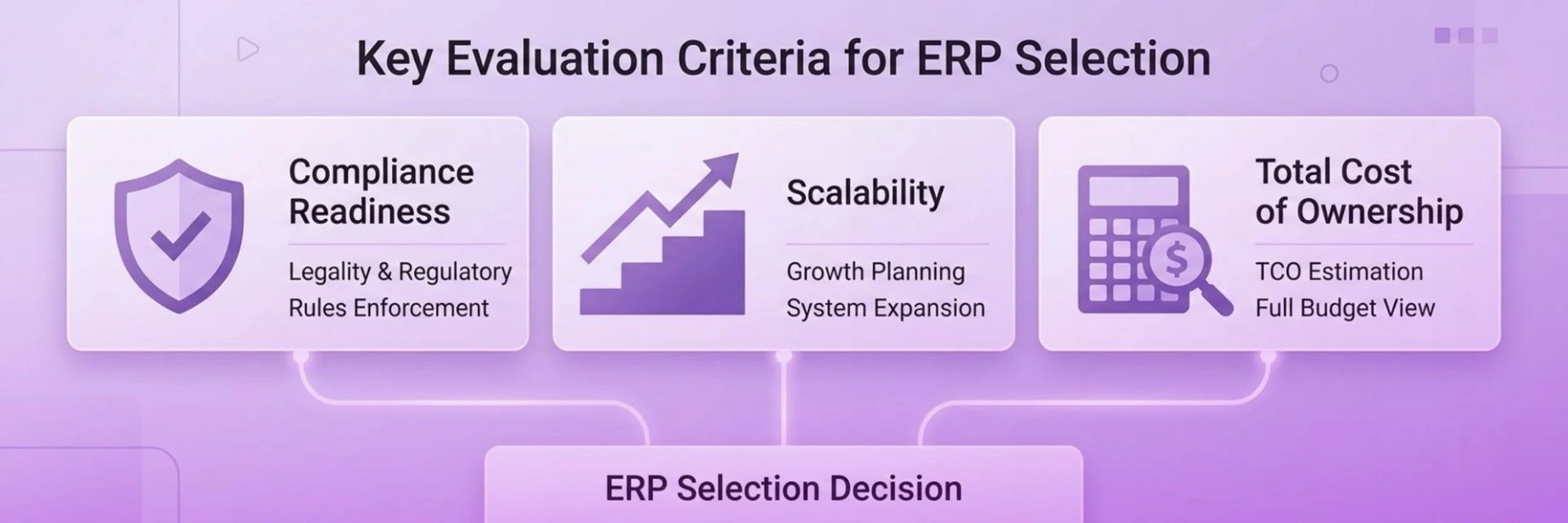
The first evaluation criterion, then, is compliance readiness: does the ERP generate FTA-compliant invoices, maintain the required audit trail structure, and support the data fields the e-invoicing mandate requires, without relying on a bolted-on third-party module that the vendor maintains separately from the core platform.
Scalability Without Re-Platforming: The Cost Most Comparisons Ignore
Small businesses in the UAE grow in patterns that are predictable in hindsight and rarely planned for at the point of ERP selection. A single-entity trading business adds a second entity in a different free zone. A services business adds an e-commerce arm. A retail operation adds a manufacturing or distribution function. Each of these transitions changes what the ERP needs to do, and many ERP platforms marketed to small businesses are architected for a single, simple use case, with growth requiring a migration to an entirely different platform.
This migration cost is rarely included in ERP comparison content, because it sits in the future instead of appearing on a current feature list. It is, however, the single largest hidden cost in small business ERP selection. Migrating from a small-business platform to an enterprise-grade one after two or three years of accumulated data, customisation, and team familiarity is materially more expensive and disruptive than selecting a platform that can scale through both phases from the outset.
The second evaluation criterion is scalability without re-platforming: can the ERP support a single-entity business today and a multi-entity, multi-module business in three years, on the same underlying platform, without requiring the organisation to migrate its data and retrain its team.
Odoo's modular architecture is relevant here on its technical merits. The platform separates core functionality into distinct, interoperable modules, accounting, inventory, CRM, manufacturing, e-commerce, that a business activates as needed without changing the underlying system. A small business can begin with accounting and invoicing, then activate inventory and CRM modules as operations expand, without a platform migration. This addresses the scalability criterion directly, independent of pricing or feature marketing.
Total Cost of Ownership: Beyond the Licence Fee
ERP pricing comparisons for small businesses typically focus on the licence or subscription fee, a number that is genuinely comparable across platforms and therefore convenient to rank. Total cost of ownership is a different calculation, and it is the one that determines whether the ERP investment is sustainable for a small business with limited cash flow.
Total cost of ownership for ERP software includes implementation cost, the cost of customisation to fit UAE-specific compliance and operational requirements, ongoing support and maintenance, the cost of training staff on the system, and the cost of any third-party add-ons required to fill functional gaps in the core platform. A platform with a low headline price and a high dependency on paid add-ons for VAT compliance, multi-currency handling, or Arabic language support can carry a higher total cost than a platform with a higher headline price and these capabilities built into the core.
For small businesses in the UAE specifically, the relevant comparison point is whether VAT compliance, e-invoicing readiness, and Arabic-English bilingual operation are native platform capabilities or paid extensions. Odoo includes UAE-specific localisation as part of its standard accounting module, VAT reporting structures, Arabic invoicing, and the data architecture required to support e-invoicing compliance sit inside the core platform, with no separate third-party add-on layer to maintain. This affects the third evaluation criterion directly: total cost of ownership stays lower when compliance-critical functionality is built into the core from the start.
Free Zone, Mainland, and Licensing Structure: An Overlooked Selection Factor
UAE small businesses operate under a wider range of licensing structures than most other markets, mainland licences, free zone licences across dozens of distinct free zones, and increasingly, multi-jurisdiction structures where a single business holds licences in more than one zone for tax, logistics, or client-facing reasons. Each of these structures carries its own VAT treatment, reporting obligation, and in some cases distinct compliance documentation requirements.
ERP comparison content written for a general market rarely accounts for this. A platform may handle single-entity, single-jurisdiction accounting well and still struggle the moment a business needs to track a free zone entity and a mainland entity separately, with distinct tax treatments, inside the same system, without someone reconciling two disconnected sets of books by hand every month.
For a small business that currently operates under a single licence but expects to add a second jurisdiction within a few years, a common pattern for trading businesses expanding from a free zone into mainland distribution, or a services business adding a second emirate presence, this is worth resolving at ERP selection time, well before the second licence is issued. Odoo's multi-company architecture allows a single instance to manage multiple legal entities with distinct tax configurations, while keeping consolidated reporting available where the business needs it. This is the same architectural principle behind GCC operating model fragmentation at enterprise scale, applied at the point where a small business first takes on a second entity.
The practical question for a small business owner evaluating ERP options is whether the platform under consideration would force a migration if multi-entity support becomes necessary in eighteen months, because that scenario is common enough in the UAE's licensing environment to deserve a direct answer before signing a contract.
A Practical Evaluation Sequence for Small Business Owners
Translating these three criteria into a practical evaluation process gives a small business owner in the UAE a structured way to assess ERP options, regardless of which specific platforms are under consideration.
Step one is mapping current and near-term compliance obligations: VAT registration status, e-invoicing mandate timeline based on revenue threshold, and any sector-specific regulatory requirements relevant to the business. This produces a compliance baseline the ERP must meet, and it should be documented before any vendor conversation begins, a business that can state its compliance requirements precisely will get more accurate answers from any vendor it evaluates.
Step two is mapping the business's likely growth trajectory over the next three to five years, additional entities, additional sales channels, additional operational functions, additional licensing jurisdictions, and assessing whether the ERP platform under consideration can support that trajectory on its existing architecture, or whether it would require a future migration. This step benefits from being deliberately conservative: most small businesses underestimate how quickly their operational footprint changes once growth begins.
Step three is calculating total cost of ownership across a three-year horizon, including implementation, customisation for UAE-specific requirements, training, and any add-ons needed to close functional gaps, not just the recurring licence fee. Vendors should be able to provide this estimate directly; reluctance to do so is itself a useful signal about how the total cost compares to the headline price.
Step four is verifying implementation partner quality independently of the platform itself. The same ERP platform implemented well and implemented poorly produces very different outcomes for a small business, because implementation determines whether the compliance configuration, the data model, and the entity structure are set up correctly from day one. A platform that meets every criterion above can still underperform if the implementation team configuring it lacks UAE-specific compliance experience.
A small business that completes this sequence before evaluating specific platforms will find that the field narrows considerably. Platforms that meet UAE compliance requirements natively, support modular growth without re-platforming, and keep total cost of ownership predictable form a smaller set than the full market of ERP software available globally, and the evaluation turns into a structured decision grounded in those three criteria.
This is the evaluation logic behind Odoo ERP implementation and consulting for UAE small businesses: the platform is recommended where it satisfies the criteria on architectural merit, not as a default. For businesses with requirements that extend beyond Odoo's standard configuration, Odoo custom development extends the platform's native architecture to match specific operational needs without compromising the compliance and scalability foundation.
What This Means for VAT and E-Invoicing Specifically
Because the e-invoicing mandate timeline is a near-term constraint for nearly every VAT-registered business in the UAE, it deserves separate attention in any ERP evaluation. A small business selecting ERP software now should confirm, specifically, whether the platform's invoicing module already supports the PINT AE structured format, whether it can connect to an FTA-accredited service provider for invoice transmission, and whether invoice records are archived in a structure that meets the five-year audit retention requirement under Federal Law No. 7 of 2017.
This is a more detailed question than most small business owners think to ask during ERP selection, and it is precisely the question that determines whether the business is still compliant in 2027 without an emergency remediation project. The pattern explored in tax compliance systems and ERP architecture applies at small business scale as much as enterprise scale: compliance requirements reshape what the system must do structurally, and a platform that was not designed with this in view requires costly correction later.
When a Modular Platform Like Odoo Is Not the Right Fit
A genuinely strategic evaluation has to name the cases where the recommended approach does not apply, and there are real ones.
A single-person freelance operation or a sole proprietorship with no inventory, no payroll, and no near-term plan to register additional entities has limited use for a modular ERP's growth capacity. The compliance and scalability criteria in this post matter most for a business that expects its operational footprint to change, additional staff, additional revenue streams, additional jurisdictions. A business that is confident its structure will stay simple for the foreseeable future may be better served by a lightweight invoicing and bookkeeping tool with a lower implementation cost and a shorter learning curve, accepting a future migration as an acceptable trade-off if growth does eventually arrive.
A business in a narrow vertical with deep, specialised operational requirements, certain healthcare practices, specific construction subcontracting models, or niche regulated trading activities, may find that a vertical-specific platform built around that exact workflow outperforms a general-purpose modular ERP on day-to-day usability, even if the general platform would technically support the same functions through configuration. In these cases, the cost of configuring a general platform to replicate what a vertical tool does natively can outweigh the scalability benefit, particularly if the business has no plans to diversify beyond that single vertical.
A business whose owner or finance lead has no internal capacity to manage an implementation project, and no budget for a qualified implementation partner, faces real risk with any modular ERP platform, the architecture's flexibility becomes a liability if the initial configuration is done poorly, since a badly configured modular system produces the same compliance and data-quality problems described earlier in this post, regardless of which platform was selected. In this scenario, a fully managed, simpler SaaS tool with a vendor-handled setup process may carry lower implementation risk, even at the cost of slower scalability later.
These exceptions do not undermine the evaluation framework. They confirm it. The three criteria, compliance readiness, scalability without re-platforming, and total cost of ownership, apply regardless of outcome. For some small businesses, applying them honestly points toward a simpler tool. For most UAE small businesses with a credible growth trajectory and at least a basic VAT compliance obligation, the same criteria point toward a modular, natively UAE-compliant platform such as Odoo. The framework, not the brand, is what should drive the decision.
Frequently Asked Questions
UAE-specific VAT requirements under Federal Decree-Law No. 8 of 2017 and the e-invoicing mandate under Ministerial Decisions 243 and 244 of 2025 impose structural requirements on invoicing, data classification, and record retention that generic global ERP comparisons do not address. A small business in the UAE should evaluate ERP platforms against these specific compliance requirements, not just against general feature sets common to ERP software worldwide.
Odoo's modular architecture supports a small business starting with core accounting and invoicing functions and expanding into inventory, CRM, manufacturing, or e-commerce modules as the business grows, on the same platform. UAE-specific localisation, VAT reporting, Arabic invoicing, and e-invoicing-ready data structures, sits inside the core platform with no paid add-on required. This combination of compliance readiness and scalability is what makes Odoo a strong fit for most UAE small businesses evaluated against the criteria in this post.
Total cost of ownership varies based on the complexity of the business and the degree of customisation required, but it always extends beyond the licence or subscription fee. Implementation, UAE-specific configuration for VAT and e-invoicing compliance, staff training, and ongoing support all contribute to the real cost. A small business should request a total cost of ownership estimate across a three-year horizon from any ERP vendor, the headline subscription price alone does not answer the question that matters.
The e-invoicing mandate applies to all VAT-registered businesses by 1 January 2027, with large enterprises required to comply from 31 July 2026. A small business should confirm its ERP platform's e-invoicing readiness now, since implementation timelines for compliance-related architecture changes typically require several months. Starting this evaluation early avoids the compressed timelines and higher costs associated with last-minute compliance projects.
Switching is possible but carries real cost: data migration, staff retraining, and a period of operational disruption during the transition. This is why scalability is one of the three core evaluation criteria for ERP selection at the small business stage. Choosing a platform with modular architecture that supports growth without requiring a full migration avoids this cost later, even if the business's current needs are simple.
A modular platform is less suited to a single-person operation with no inventory, payroll, or near-term plans for additional entities, where a lightweight invoicing tool may be more cost-effective despite limited growth capacity. It can also underperform a vertical-specific tool in niche regulated industries with deep, specialised workflows. A business with no internal capacity and no budget for a qualified implementation partner also faces real configuration risk with any modular platform, regardless of brand, in that case, a fully managed, vendor-configured SaaS tool may carry lower implementation risk.
Advisory note: Regulatory references in this post reflect publicly available UAE Federal Tax Authority and Ministry of Finance documentation as of the date of publication. Specific compliance requirements and deadlines should be confirmed with qualified legal and tax advisors before making implementation decisions.
Strategic Takeaway: Evaluate the Architecture, Not the Feature List
The question "what is the best ERP software for a small business in the UAE" does not have a single correct answer, because the right platform depends on the business's compliance obligations, growth trajectory, and cost structure — not on a ranked feature comparison that treats every small business as identical.
The evaluation framework that produces a reliable decision asks three questions: does the platform meet UAE compliance requirements natively, can it scale with the business without a future migration, and is its total cost of ownership predictable across a multi-year horizon. A small business owner who answers these three questions before comparing specific platforms will make a decision that holds up as the business grows, even as growth, compliance, or cost pressure changes the requirements around it.
Related Insights
For further reading on how ERP architecture, compliance design, and platform scalability intersect for UAE businesses: