
What Every CEO, COO and CFO Needs to Know in 2026
The Middle East is highly confident in its AI adoption trajectory, yet many organizations remain structurally unprepared to govern it at scale. While most enterprises have experimented with AI tools, few have built the foundational infrastructure, data consistency, and governance required to turn experiments into durable business value. This guide provides a practical framework for executives to transition their operations from isolated AI interest to scalable AI performance.
The Readiness Gap
The gap between talking about AI and running AI is wider than most executive teams realize.
Boards are discussing AI strategy. Leadership teams are tracking competitor movements. Pilot programs are launching constantly some showing promise, others quietly shutting down. Most enterprises lack the infrastructure to make AI work effectively.
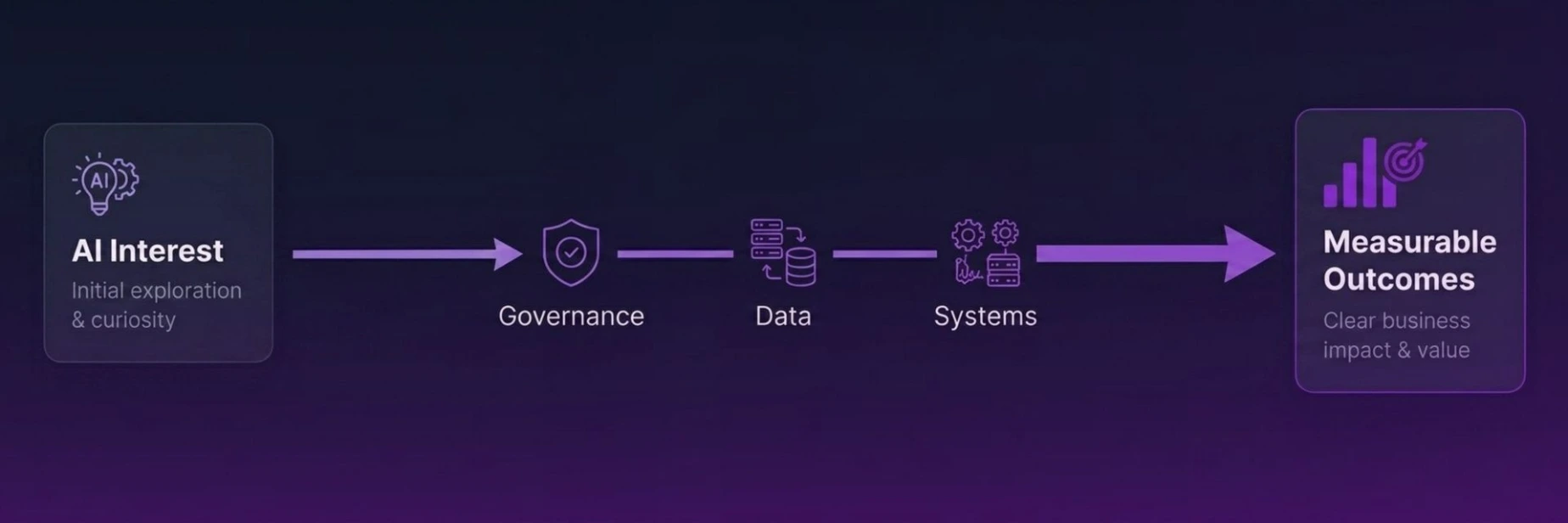
What is missing is not ambition. It is the organizational foundation: data quality, governance frameworks, and system architecture. These are what separate AI experiments from measurable ROI.
For CEOs, COOs, and CFOs in the UAE and wider GCC, this distinction carries significant commercial weight. The region is firmly positioning itself as a global hub for digital transformation and AI investment. However, capturing this opportunity requires a shift in executive focus moving away from evaluating which AI tools to buy, and toward assessing whether the organization is structurally ready to operate them.
The Middle East Opportunity and the Readiness Gap
Industry analysis consistently shows that Middle East business leaders report exceptional confidence in AI adoption and domestic economic growth. Saudi Arabia and the UAE are securing their positions as top global investment destinations, backed by massive state-led commitments to digital infrastructure and data-center expansion.
The commercial environment is highly favorable. The challenge lies in translating this regional momentum into enterprise-level execution.
Recent market data reveals that while technical capabilities are advancing globally, only a fraction of organizations have reached maturity in the areas that dictate sustained AI value: strategy alignment, governance structures, and controls for autonomous systems. Organizations investing heavily in responsible AI frameworks and operational excellence are the ones reporting material financial impact.
A local example: Consider a prominent multi-entity retail group in the UAE. Over 18 months, they launched three separate AI pilot programs aimed at supply chain forecasting and inventory optimization. All three failed to reach operational scale. The root cause was not a flaw in the AI technology it was operational fragmentation. Mismatched product classifications, disconnected data silos, and inconsistent multi-entity reporting across their subsidiaries meant the AI was training on fundamentally flawed data. The project stalled before it could ever generate value.
Generative AI vs. Agentic AI: The Crucial Distinction
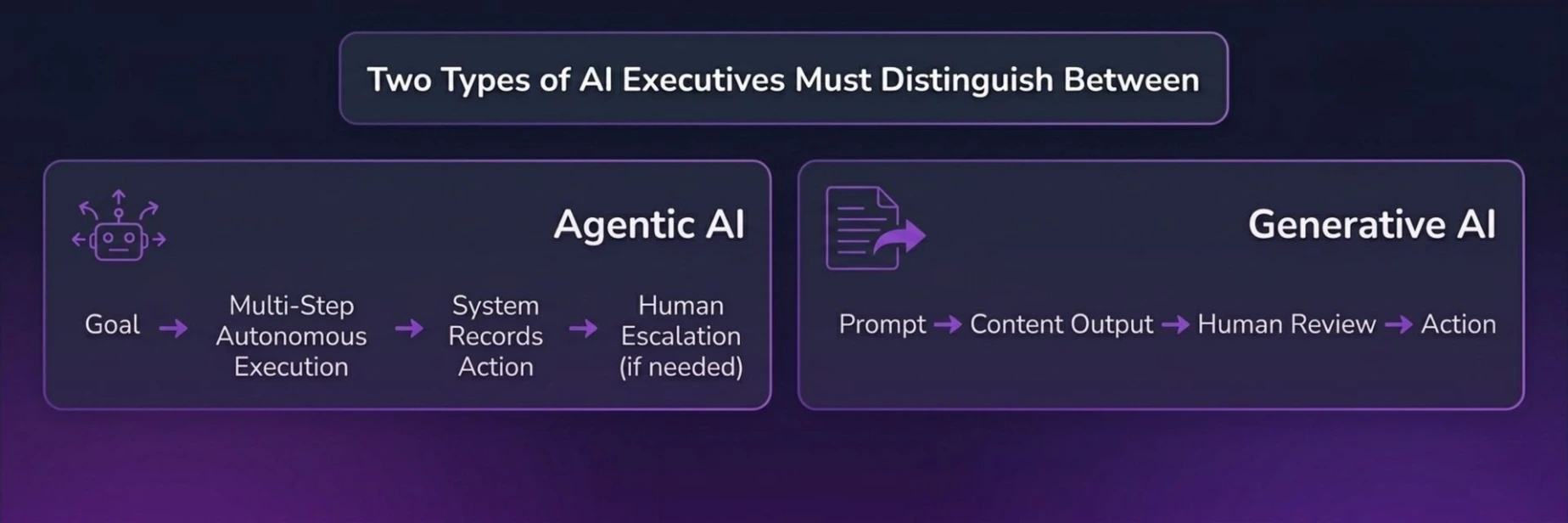
Before shaping strategy, executives must understand the distinction between generative AI and agentic AI. This technical difference fundamentally alters organizational risk and governance requirements.
Generative AI acts as a productivity layer. It produces content, code, or analysis in response to a user prompt. A human directs the system, and a human reviews the output before taking action.
Agentic AI pursues goals autonomously across multiple steps. It plans, interacts with enterprise tools, executes actions, and adjusts based on outcomes with limited human intervention.
For executives, this distinction is critical. If a generative AI drafts an inaccurate report, a human catches it. If an agentic AI takes an incorrect action within an operational workflow such as approving a flawed transaction, updating a core record, or generating a non-compliant invoice the damage is done before a human is ever aware.
Security and risk constraints, rather than technological limits, are the primary barriers to scaling agentic AI. Organizations are constrained by their confidence in their ability to govern what the system does autonomously.
Why Most AI Pilots Do Not Scale
Across the enterprise landscape, a significant majority of organizations are piloting AI, but very few are successfully operating these systems at scale. This failure rate has consistent, structural causes:
The data foundation is incomplete.
AI systems require clean, governed data to operate reliably. Most legacy enterprise data environments are highly fragmented. Data models differ across business units, requiring manual reconciliation. Embedding AI into this environment amplifies existing data inconsistencies rather than solving them.
Governance structures are absent.
Executive teams are pressured to show measurable outcomes, yet the mechanisms to ensure those outcomes AI ownership structures, risk thresholds, and accountability frameworks are underdeveloped.
System architecture cannot support AI execution.
Traditional ERP systems and operational platforms were built for human-initiated workflows. Retrofitting high-speed, autonomous AI capabilities into legacy infrastructure produces fragile implementations that break under daily operational stress.
Organizations that successfully scale AI treat data quality, governance, and infrastructure alignment as strict prerequisites. For enterprises dealing with disconnected systems, engaging in unbiased ERP advisory and architecture redesign is the necessary first step not AI tool selection.
A Practical Framework for Executives: Four Key Decisions
The following four decisions provide a direct, actionable framework for the C-Suite to ensure AI investments translate into operational excellence.
Decision 1: Define “Value” Before Selecting Tools
AI programs stagnate without a clear executive definition of value. Launching initiatives due to competitive pressure or vendor demonstrations does not constitute a business strategy.
A proper value definition targets a specific operational process, establishes a measurable baseline, and projects a clear target improvement. For CFOs, this means requiring a rigorous business case and ROI estimate before any AI investment is approved.
Decision 2: Assess Data Readiness Before Technology Readiness
Evaluating AI vendors is secondary to evaluating your own data infrastructure. AI requires consistent structuring across the organization, complete data fields, and enforced governance to maintain quality over time. In multi-entity organizations across the GCC, multi-entity process design is the ultimate test of data readiness. If data consistency does not exist across your subsidiaries, it must be addressed prior to AI deployment.
Decision 3: Establish Governance Before Autonomy
AI trust is a business enabler, not merely a compliance checkbox. Executives must explicitly define:
Who owns AI performance?
What actions are systems authorized to take autonomously?
How are errors escalated to human reviewers?
Leading enterprises ensure every AI agent operates with a digital identity and full auditability. Governance architecture must be established before AI systems are granted operational authority.
Decision 4: Sequence Infrastructure Investment First
Projections indicating significant cost reductions through AI automation are only valid for organizations with modular, composable, agent-ready architectures. An AI agent meant to accelerate financial closing requires an ERP foundation with consistent data models and embedded audit trails the same architectural discipline described in our work on technology alignment with operating model design. The technological capability is arriving quickly; the pressing question is whether your underlying infrastructure is prepared to support it.
What This Means Specifically for GCC Enterprises
The GCC context introduces specific variables that executives must navigate strategically.
The evolving regulatory environment
UAE e-invoicing requirements, FTA audit obligations, and new data governance frameworks impose strict structural demands on enterprise systems. An AI agent processing ERP transactions must adhere to the exact same compliance constraints as a human operator. Tax compliance and ERP architecture are essentially the same infrastructure challenge when preparing for AI.
The knowledge gap
The pace of state-level AI investment is currently outpacing internal enterprise capability. Organizations that actively build internal AI literacy across their executive and operational tiers will gain a massive compounding advantage over those who entirely outsource their AI strategy to vendors.
Frequently Asked Questions
Frequently asked questions
AI adoption is deploying tools and running pilots. AI readiness is having the organizational infrastructure (data quality, governance, system architecture) that allows those tools to generate durable ROI. Readiness must precede adoption to achieve scale.
Demand a targeted business process, a clear baseline for current costs, and a measurable improvement target. Ensure the data feeding the AI is governed and that clear escalation paths exist for autonomous decisions.
Pilots usually run on curated, clean data in controlled environments. When exposed to the fragmented data, high operational volumes, and complex workflows of the real enterprise, systems lacking foundational architecture break down.
Pilots usually run on curated, clean data in controlled environments. When exposed to the fragmented data, high operational volumes, and complex workflows of the real enterprise, systems lacking foundational architecture break down.
Strategic Takeaway: The Work Before the Work
The executives who will dominate the next era of GCC business are not necessarily the ones most enamored with AI technology. They are the leaders willing to execute the unglamorous preparatory work: consolidating data foundations, enforcing governance structures, and redesigning system architecture before pushing AI into production.
The AI opportunity in the Middle East is genuine, but the infrastructure gap is equally real. Organizations that systematically close this gap first will secure a decisive, long-term operational advantage.
Related Insights
For further reading on how ERP architecture, compliance design, and system governance create the foundation for AI-ready enterprise operations: