
Why Digital Growth Investments Stall Despite the Budget
A practical framework for knowing what to fix before spending to grow
Introduction
A company decides to scale. It commits to more infrastructure, more tools, more automation, and months later the results fall short of the spend. The explanation reached for first is usually that the investment was too small. The more accurate one is that the operation was never measured before it was scaled.
Scaling amplifies whatever is already there, including the inefficiency. The step that gets skipped is a baseline: a concrete record of how the operation performs today, captured before the budget is committed. It is the cheapest part of the entire process and the one most often left out.
Why Scaling Without Measurement Backfires
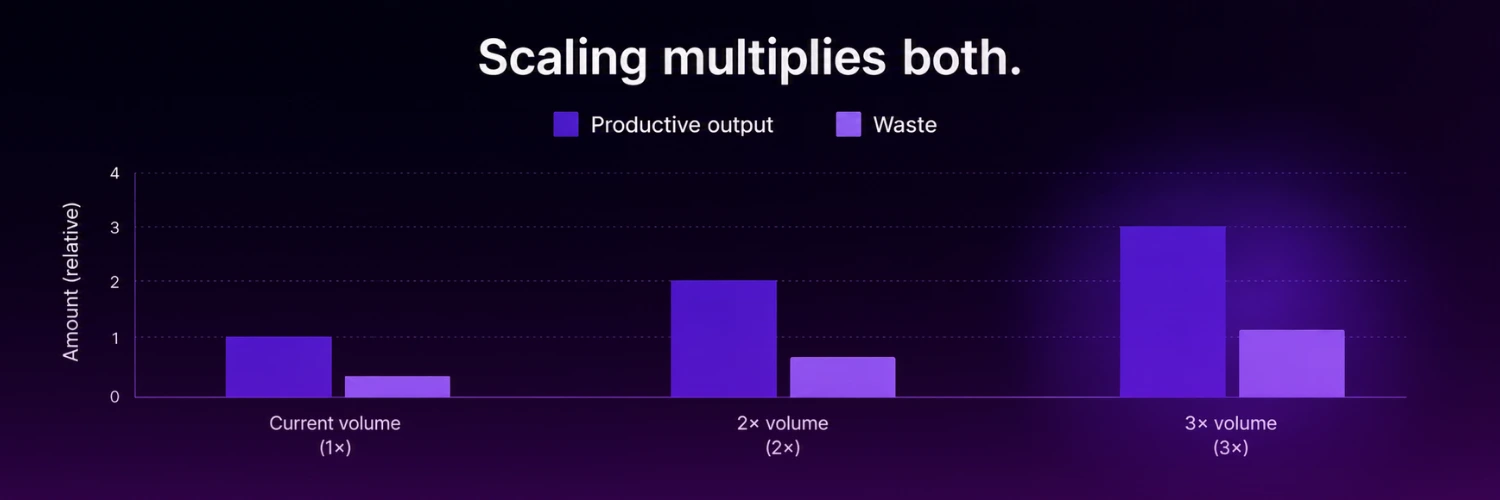
Amplification is the point of scaling. It works on waste exactly as well as it works on output. A process that loses a small amount of time per transaction loses a large amount once volume triples. A bottleneck that was tolerable at current throughput becomes the ceiling the entire business hits at the next level.
There is a second effect that is easier to miss. Investment made without a baseline cannot be evaluated afterwards. When performance improves, nobody can say by how much or which change produced it. When it does not improve, the diagnosis defaults to insufficient budget, and the next round of spending repeats the same pattern at a larger scale.
The Four Numbers Most Companies Cannot Produce
Ask a growing business to state the following four figures without a delay, and most cannot:
• Cost per transaction, calculated end to end rather than by department.
• True margin per product or service line, after the labour actually consumed to deliver it.
• Cycle time from order to fulfilment, including the waiting periods between steps.
• The current bottleneck, identified by measurement rather than by which team complains most.
Every scaling decision made without these four is a decision made on assumption. Assumptions that were harmless at the current size become expensive at the next one, because the cost of being wrong scales alongside everything else.
A Framework for Measuring First
Step 1: Establish the baseline before the budget
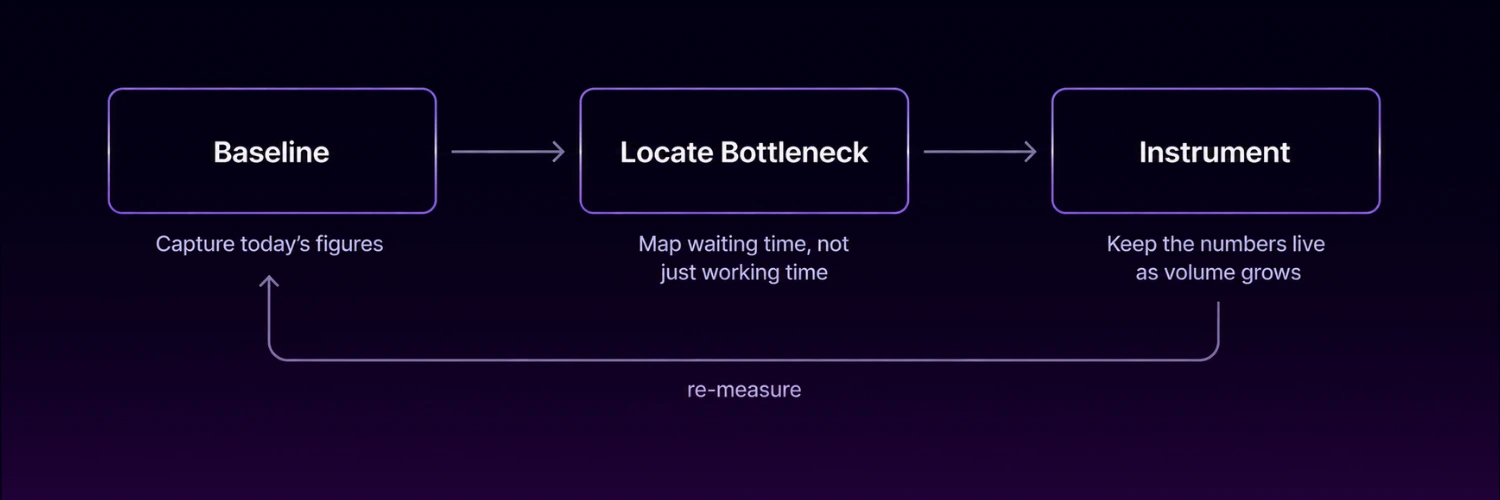
Capture how the operation performs today in specific figures: throughput per period, cost per unit of work, error and rework rates, and cycle time by stage. Record the conditions alongside the numbers, including headcount, seasonality, and any temporary factors, so the comparison later stays honest. Two weeks of clean measurement is usually enough to establish a defensible starting point.
Step 2: Locate the real bottleneck
The constraint a team believes it has and the one it actually has are frequently different. Mapping the flow of work end to end, with the waiting time between stages recorded separately from the working time, tends to reveal that the delay sits somewhere other than where the budget was about to go. Waiting time is where most of it hides, and it rarely appears in any existing report.
Step 3: Instrument the operation so growth stays visible
Measurement has to survive the scaling itself. An operation measured once and then scaled blind loses the ability to detect a new constraint forming until it is already causing damage. Instrumentation means the same figures continue to be produced automatically as volume rises, from the systems already running the work rather than from a periodic manual exercise.
What to Do With the Baseline
A baseline earns its cost at the decision point. Before committing, the investment case states which of the measured figures it is expected to move and by how much. After deployment, the same figures are re-measured under comparable conditions.
This produces three outcomes worth having. The investment either moved the number it targeted, moved a different one, or moved nothing. Each of those is actionable, and none of them is available to a business that never captured the starting point.
The UAE Context
The pattern is sharper in the UAE than in slower-growing markets. Businesses here often scale across entities, jurisdictions, and currencies within the same period, which means an unmeasured inefficiency is replicated into every new entity as it is set up rather than corrected once.
Regulatory timelines add a second pressure. With e-invoicing compliance required from January 2027 and reporting obligations tightening across the GCC, operations are being rebuilt on a fixed schedule regardless of readiness. A business that already holds a measured baseline can sequence that work against real bottlenecks. A business without one is committing budget to a deadline rather than to a diagnosis.
Conclusion
Businesses that scale successfully share one habit: they knew precisely what they were scaling before they spent, because they measured it. A baseline turns a scaling decision from a bet into an informed move, and it costs less than any other step in the process.
Measurement is where an ERP system earns its place in a growth plan, because it produces the operational figures a scaling decision depends on as a by-product of running the work.
Frequently Asked Questions
Most often because the operation was never measured before it was scaled, so the investment amplified existing inefficiencies instead of removing them. Without a starting point, there is also no way to tell afterwards whether the spend worked.
Capturing concrete performance figures before committing budget: throughput, cost per unit of work, error and rework rates, and cycle time by stage, recorded alongside the conditions that produced them.
Roughly two weeks of clean measurement is usually sufficient for a defensible starting point, provided the period is representative and any temporary factors are recorded.
By mapping work end to end and recording waiting time separately from working time. The waiting periods between stages are where most delay accumulates, and they rarely appear in existing reports.
It is typically the cheapest and highest-leverage step in the sequence. Skipping it costs considerably more later, when the investment amplifies a problem nobody quantified.
An ERP system produces the operational figures a scaling decision depends on as a by-product of running the work, which replaces periodic manual data collection with a measurement layer that survives growth.
Related Insight
• Digital Strategy: Planning Technology Investment for Growth