
A Five-Year View of Enterprise Software
How to model what a system costs to run, before signing for what it costs to buy
Introduction
Software budgets get approved on the purchase price and exceeded on the running cost. Licensing is the number that appears in every proposal, gets compared across vendors, and anchors the decision. It is also the one cost that behaves predictably.
The costs that determine the real total surface after go-live, recur annually, and appear in no vendor quote. They are estimable in advance, and a five-year model that includes them frequently reverses the ranking produced by the initial comparison.
Why the Purchase Price Is the Smallest Number
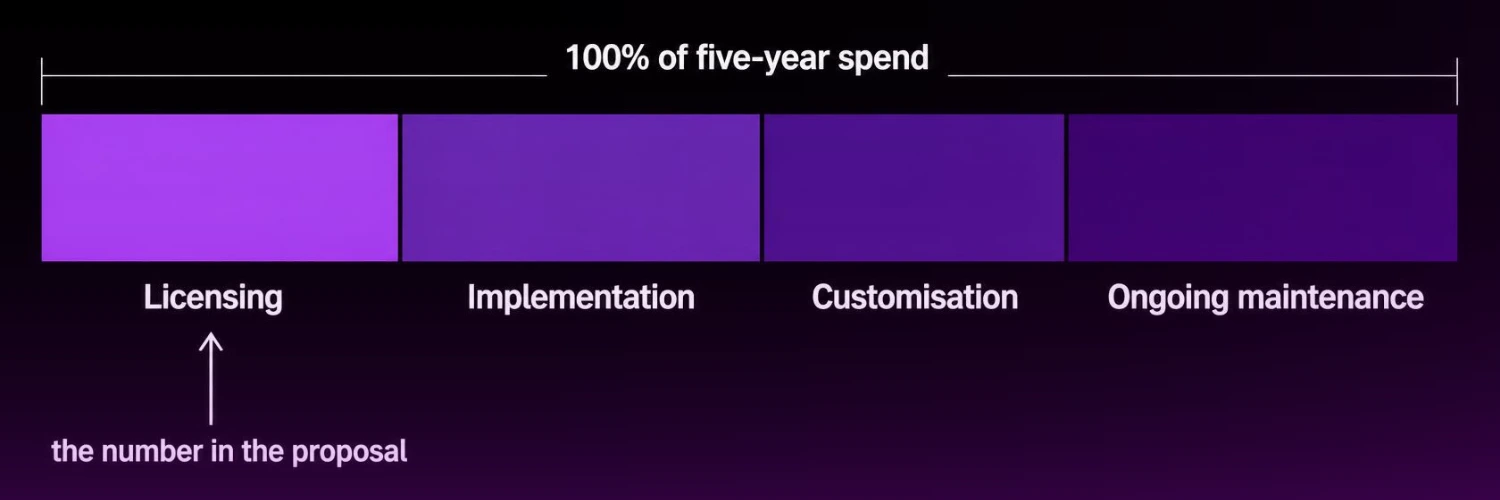
Across major enterprise platforms, licensing accounts for roughly a quarter to a third of five-year spend. The remainder sits in implementation, customisation, integration, and the maintenance that compounds with every subsequent upgrade.
This distribution holds regardless of platform, which has a specific consequence for procurement: a comparison built on licensing alone is comparing the smallest and most similar component of two totals that may differ substantially. Two systems within a few percent of each other on license cost can separate by a wide margin once the running costs are modelled.
The Four Costs That Surface After Go-Live
1. Integration maintenance
Every connection between the new system and an existing one is a dependency that requires attention whenever either side changes. A payment gateway updates its API, a logistics provider changes a file format, a tax authority revises a submission schema, and each of those consumes development hours that were never scoped.
This cost scales with the number of integrations rather than with users, which is why it is routinely underestimated by businesses buying on a per-seat comparison. A practical estimate: budget annual maintenance hours per integration rather than a single figure for the system as a whole.
2. Data growth and storage
Transaction volume produces data, and that data accumulates under retention obligations that are usually longer than anyone assumes at selection. Storage costs rise on a curve that follows business growth, which means the fastest-growing businesses face the steepest increase in the component they modelled least carefully.
Archiving policy is the lever here, and it is far cheaper to define before go-live than to apply retroactively to five years of accumulated records.
3. Retraining through staff turnover
Implementation budgets include training once, delivered at launch to the team present at launch. Turnover then erodes that investment continuously. Within a few years, a meaningful share of the people operating the system were never trained on it formally and learned it from colleagues, including the workarounds.
The cost appears indirectly, as slower processing, higher error rates, and a gradual drift away from the configured process. It is rarely attributed to training, which is why it rarely gets funded.
4. Workaround labour
Every manual step that survives go-live is recurring labour the system was purchased to remove. A report rebuilt in a spreadsheet each month, a reconciliation done by eye, a form filled twice because two systems do not exchange the field.
These are individually small and collectively substantial, and they are the most measurable of the four. Counting the hours spent on manual steps that the system was specified to handle produces a direct annual figure, and it is usually larger than expected.
How a Five-Year Model Changes the Ranking
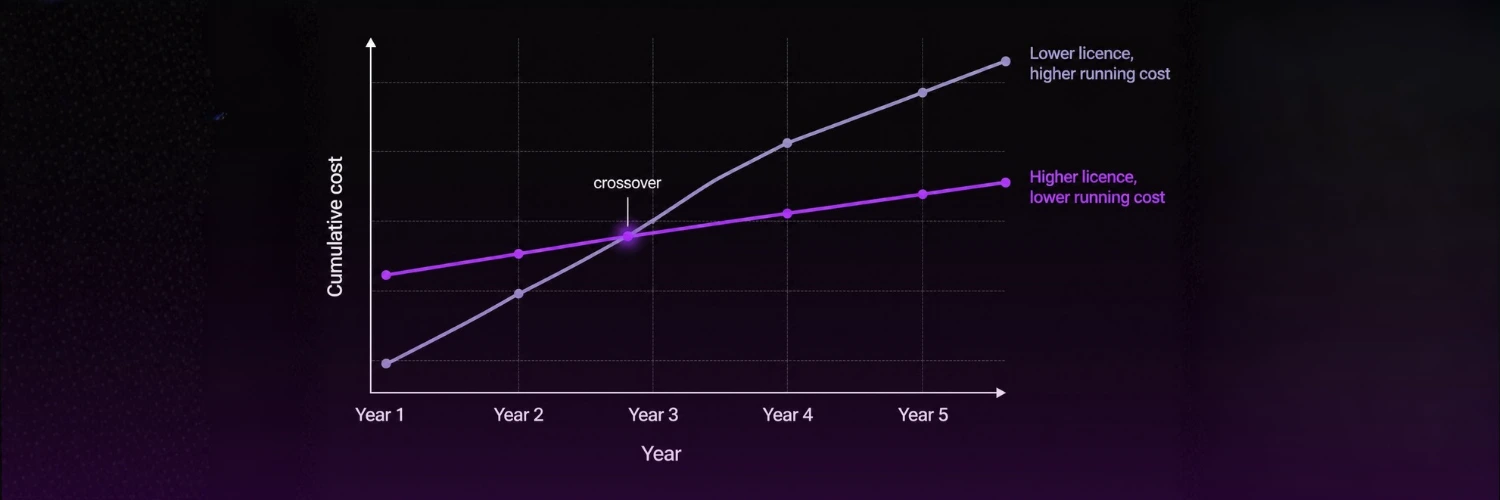
Consider two systems where the second carries a higher license cost. If the second requires fewer custom integrations, ships the reports the business actually needs, and handles multi-entity structures without modification, its running costs are lower across all four categories simultaneously.
The reversal happens because these costs recur while the license difference is largely fixed. A gap that appears at selection as a one-time premium is repaid annually, and the crossover typically falls within the first three years.
The reverse case is equally common. A lower-priced system that requires extensive customisation to fit the business carries that customisation into every future upgrade, and the accumulated cost of maintaining it can exceed the license saving that justified the choice.
Building the Model Before You Sign
A workable five-year model requires figures that are available before signing, provided the questions are asked during evaluation rather than after.
• Count the integrations required, and request the vendor’s upgrade frequency and backward-compatibility policy for each connection point.
• Project data volume at expected growth rates against the retention period the business is actually subject to.
• Apply the organisation’s historical turnover rate to the roles that operate the system, and budget retraining on that cycle rather than once.
• List the manual steps in the current process and mark which ones the new system genuinely removes, with each remaining one costed at its annual hours.
• Request the cost of a version upgrade, including the effect of any customisation being proposed, in writing.
The last of these is the most revealing question in an evaluation, and the one least often asked.
The UAE Context
Two local factors weight the model further toward running costs. Multi-entity structures are common, and the number of entities drives integration count, reporting complexity, and data volume simultaneously, which means three of the four costs scale together rather than independently.
E-invoicing compliance adds a second factor with a fixed date. Businesses above AED 50 million must appoint an Accredited Service Provider by 30 October 2026, with full compliance required from 1 January 2027. That connection is a permanent integration subject to regulatory change, which places it firmly in the first cost category for the life of the system rather than as a one-time project.
Conclusion
The purchase price is the most visible number in a software decision and the least informative one. The four costs that follow go-live recur annually, scale with the business, and are estimable in advance from questions asked during evaluation.
A five-year model built on those figures produces a different and more reliable ranking than a license comparison, and it is assembled from information vendors will provide when asked directly.
Frequently Asked Questions
Across major enterprise platforms, licensing typically represents roughly a quarter to a third of five-year spend. The remainder sits in implementation, customisation, integration, and ongoing maintenance.
Integration maintenance, because it scales with the number of connected systems rather than with users, and because each connected party changes on its own schedule rather than yours.
List the manual steps in the current process, mark which ones the new system genuinely removes, and cost the remainder at their annual hours. Steps that survive go-live are recurring labour the system did not eliminate.
Custom code has to be revalidated and often rebuilt at every version upgrade. The cost recurs on the upgrade cycle for as long as the customisation remains in place.
Frequently. When a higher license cost buys fewer required integrations, native handling of the business structure, and reporting that works without modification, the running costs fall across several categories at once and the crossover usually occurs within three years.
What a version upgrade costs, including the effect of any customization being proposed, requested in writing. The answer exposes the recurring maintenance burden the license figure conceals.
Related Insight
• ERP and Technology Trends to Watch in 2026
• Digital Strategy: Planning Technology Investment for Growth