
Edge Computing for UAE Enterprises:
When Processing Data Near Its Source Actually Pays Off
A decision guide for choosing between the edge and the central cloud, one workload at a time
Introduction
Edge computing, processing data close to where it is generated instead of sending everything to a central cloud, is often discussed as a direction every enterprise should be moving in. The useful version of the question is narrower. For a specific set of workloads, the edge removes a real constraint. For the rest, it adds hardware, management overhead, and cost that the central cloud would have absorbed without difficulty.
Three conditions decide which category a workload falls into. This article covers those three, how improving network infrastructure changes the weight of each, and which UAE sectors most often meet them.
What Edge Computing Actually Is
In a conventional cloud setup, data travels from a device to a central data center, gets processed, and travels back. Edge computing moves the processing step closer to the source, onto a local server, a gateway, or the device itself, so the round trip to a distant data center is shortened or removed entirely.
The central cloud continues to handle storage, heavy analytics, and coordination across sites. The edge takes only the work that cannot absorb the round-trip delay or the transfer cost. The two operate together in almost every real deployment.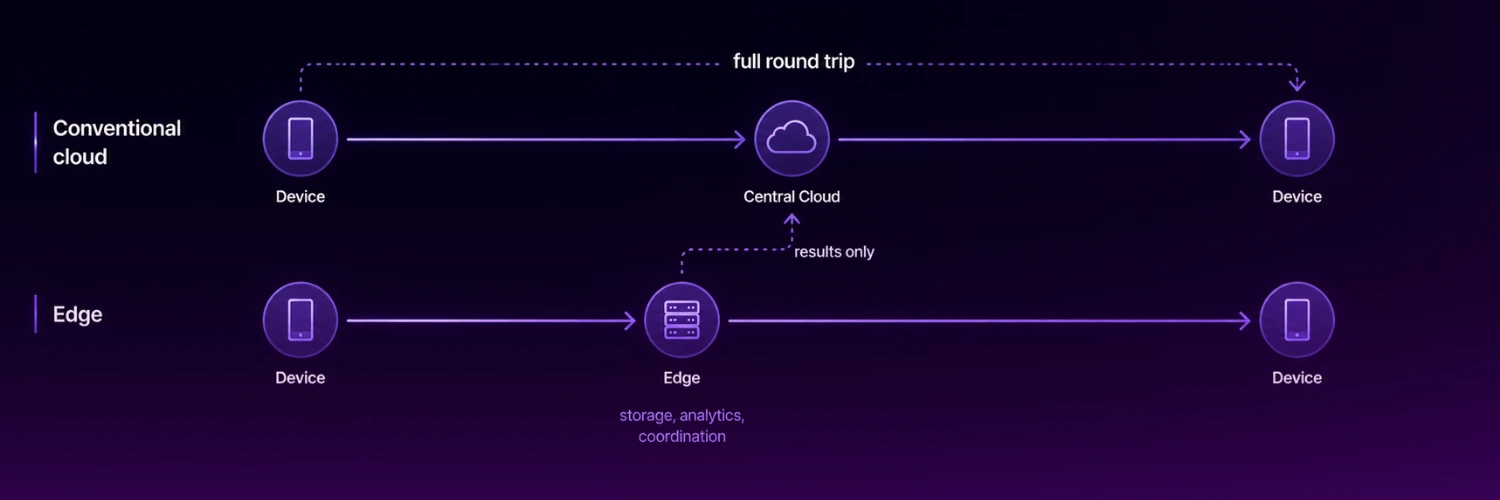
The Three Conditions That Decide It
Latency: does a delay cause a real consequence?
For a dashboard refreshing every few minutes, a few hundred milliseconds of round trip is invisible. For a safety interlock on a production line that has to react within a fixed window, the same delay determines whether a machine stops in time. The edge earns its place where the delay produces an operational consequence, rather than where it is merely measurable.
A practical test: state what happens if the response arrives 300 milliseconds later than it does now. If the answer is nothing that anyone would notice, latency is not the reason to move to the edge.
Bandwidth: how much raw data is being generated locally?
A facility producing continuous high-volume data, video feeds, machine telemetry, high-frequency sensor streams, can spend more moving that raw data than processing it would ever cost. Processing at the edge and forwarding only the results converts an expensive transfer problem into a manageable one.
The threshold is a ratio rather than an absolute figure. When the volume of raw data substantially exceeds the volume of the conclusions drawn from it, the transfer is carrying weight that has no destination.
Connectivity: what happens when the connection drops?
A remote site, a vehicle fleet, or an offshore operation cannot depend on a constant link to a central cloud. Edge processing allows critical functions to continue locally and reconcile once the connection returns, instead of halting the moment connectivity does.
This is the condition most often discovered after deployment rather than before it, because connectivity is usually tested at the head office and assumed everywhere else.
How Faster Networks Change the Calculation
Network improvements, including the UAE national 6G program, alter the weight of these three conditions unevenly, and the distinction matters when planning infrastructure several years out.
Lower latency shrinks the first condition. Work that previously had to run locally to avoid a perceptible delay can move back to a central platform, which brings cost, security, and update cycles onto infrastructure the business controls directly. This is a genuine shift, and it will reduce the number of workloads that qualify for the edge on latency grounds alone.
The second and third conditions do not move. Bandwidth cost is a function of data volume, and a faster connection does not make a continuous video feed cheaper to ship in full. Connectivity reliability at a remote site is a physical and geographic constraint, not a speed problem. A workload that qualifies for the edge on either of those grounds continues to qualify regardless of how fast the network becomes.
The planning conclusion follows directly: latency-driven edge deployments should be reviewed against the network roadmap before further hardware is committed, while volume-driven and connectivity-driven deployments can be planned as durable architecture.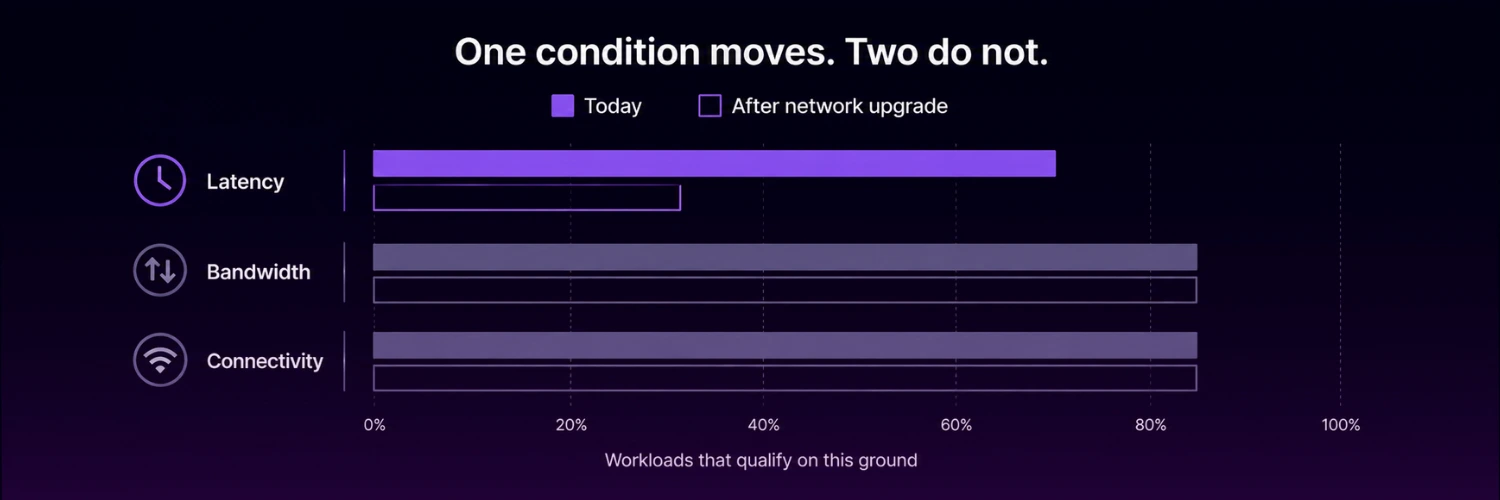
Which UAE Sectors Meet These Conditions
Manufacturing sits in the latency and bandwidth cases simultaneously. Real-time quality inspection needs a response inside the production cycle, and vision systems generate volumes of image data that are expensive to transmit in full. Under Operation 300bn, industrial capacity across the UAE continues to expand, which raises the number of sites where this applies.
Logistics fits the connectivity case most clearly. Fleets and shipments cross areas with variable coverage, and tracking, scanning, and proof-of-delivery functions have to continue working through the gaps and reconcile afterwards.
Retail meets the bandwidth case in larger formats, where in-store analytics and smart inventory generate local data that would otherwise flood the central platform for limited additional insight.
Energy and utilities operating remote or offshore assets meet the connectivity case on the same terms as logistics, with the added factor that a supervisory function stopping is an operational safety matter rather than a delay.
For a standard office application, a corporate website, or a back-office system, the central cloud remains the simpler and cheaper choice, and no network change alters that.
Conclusion
Edge computing is a specific answer to three specific problems: a latency delay with an operational consequence, local data volume that outweighs the conclusions drawn from it, and an operation that has to survive a dropped connection. Workloads meeting one of those are worth evaluating properly. Workloads meeting none of them are usually well served by the central cloud already.
The decision is made per workload rather than per organization, and it is worth revisiting as the network roadmap advances, because one of the three conditions is moving and two are not.
Frequently Asked Questions
No. The two operate together. The edge handles latency-sensitive or bandwidth-heavy processing locally, while the central cloud continues to handle storage, heavy analytics, and coordination across sites.
Three questions decide it: does a processing delay cause a real operational consequence, is local raw data volume high relative to the conclusions drawn from it, and does the operation have to keep running when connectivity drops.
It reduces the number of workloads that qualify on latency grounds, because more work can run centrally without a perceptible delay. It does not affect the bandwidth or connectivity cases, which are physical constraints rather than speed problems.
It can, because it introduces local hardware and its management. It pays off specifically where it removes a latency constraint or reduces expensive data transfer, rather than as a default architectural choice.
Manufacturing, logistics, retail at larger formats, and energy or utilities with remote assets most often meet the latency, bandwidth, or connectivity conditions that make the edge worthwhile.
It is most common there, but any operation generating high local data volume or requiring processing to continue without a connection can qualify, including operations with no conventional IoT deployment.
Related Insight
• ERP and Technology Trends to Watch in 2026
• Digital Strategy: Planning Technology Investment for Growth