Reporting Chaos has become one of the most critical operational threats facing multi-entity companies today. It doesn’t surface through alarms or system errors. Instead, it hides inside operational fragmentation, inconsistent financial consolidation, data silos, and delayed reporting cycles that slowly erode profitability.
For Group CFOs and Finance Directors, this issue isn’t abstract. It directly affects margin, decision making speed, and the accuracy of financial visibility across entities.
How Reporting Chaos Starts Before Anyone Notices
Most organizations don't recognize reporting fragmentation when it begins. It starts with minor mismatches, small reconciliation issues, or a spreadsheet created to “fix” a recurring inconsistency.
Over time, these small issues evolve into structural problems:
- Financial consolidation takes longer every period
- Entity reports use inconsistent definitions
- Teams build shadow spreadsheets to repair output
- KPIs shift meaning across departments
- Leadership receives delayed or partial visibility
This is how Reporting Chaos becomes a silent operational burden one that finance teams adapt to without realizing the cost.
Industry research on consolidated financial reporting challenges highlights how reliance on spreadsheets, inconsistent data structures, and manual consolidation are among the leading causes of reporting delays and inaccuracies. This aligns with World Bank guidance, which emphasizes that many multi-entity groups operate with “different accounting systems” or lack minimum system requirements, making it difficult to produce reliable consolidated financial data.
Organizations that operate without unified accounting policies across their entities often struggle to produce consistent and comparable financial information. When reporting logic differs from one subsidiary to another, data becomes unreliable, reporting cycles slow down, and structural fragmentation increases the same early indicators of Reporting Chaos that frequently appear in growing multi-entity companies.
Furthermore, according to World Bank corporate governance guidance, unreliable financial reporting, extended cycles, and fragmented data structures reduce transparency and increase operational and compliance risk reinforcing how small reporting mismatches can evolve into systemic complexity inside multi-entity groups.
Why Multi-Entity Companies Are More Vulnerable
Every additional entity introduces:
- different accounting systems
- local process variations
- unique reporting structures
- different interpretations of financial definitions
- growing reliance on manual adjustments
This diversity creates data silos, weakens consolidation accuracy, and slows down every step of the reporting chain.
In a multi-company group, these variations no longer remain isolated they turn into systemic operational fragmentation.
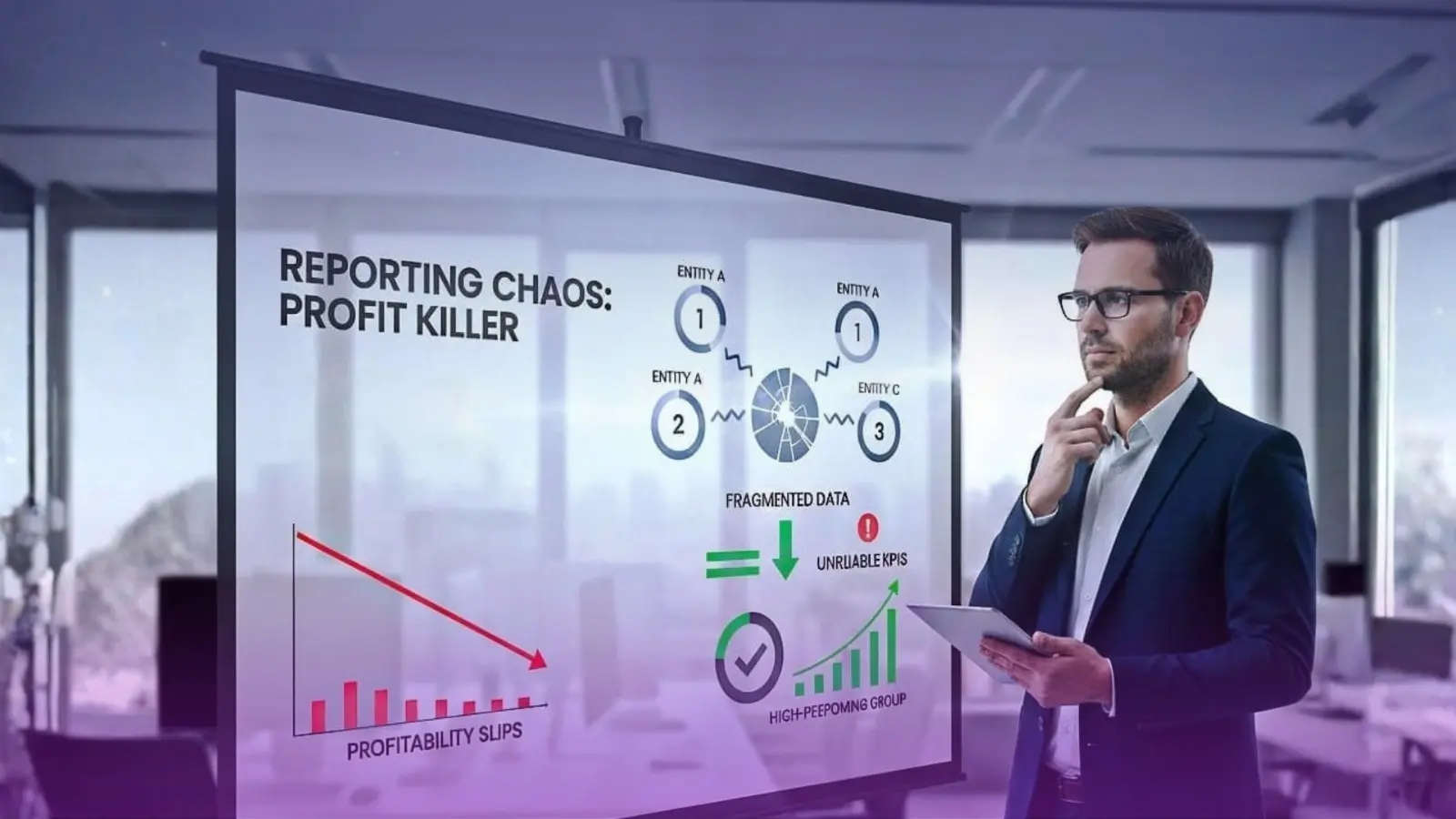
How Reporting Chaos Quietly Damages Profitability
1. Slower Financial Consolidation
When reporting cycles extend from days into weeks, leadership loses its ability to act on time sensitive insights. This directly impacts strategic execution and working capital control.
2. High Hidden Cost of Manual Work
Reconciliation and data cleaning often become a full-time activity. This hidden cost rarely appears on the P&L but drains team capacity and increases operational inefficiency.
3. Functional Misalignment Across the Organization
When sales, operations, procurement, and finance work from different data, performance decisions become fragmented. This misalignment results in margin leakage and planning inaccuracies.
4. Increased Compliance and Audit Risk
Fragmented reporting structures create inconsistent internal controls and elevate audit complexity. Fixing these issues retroactively becomes expensive.
5. Declining Confidence in Financial Data
When executives question the reliability of the numbers, decisions slow and risk tolerance decreases. Financial clarity becomes compromised.
Early Warning Signs of Reporting Chaos
The earliest signals of reporting chaos often appear subtly: reliance on manual reconciliation grows, multiple systems begin producing different results, and shadow spreadsheets expand across teams. Month end cycles gradually extend, KPIs lose unified definitions, and maintaining a consistent reporting structure becomes increasingly difficult. These patterns point to deeper architectural issues rather than team performance problems, indicating that the organization’s reporting foundation needs reinforcement.
The Real Issue: Silent Adaptation
Organizations often normalize fragmented reporting:
- Workarounds become permanent
- Manual tasks become expected
- One employee becomes the “source of truth”
- Processes depend on people instead of systems
This adaptation creates risk, slows scalability, and makes financial consolidation increasingly fragile.
How High-Performing Multi-Entity Groups Break the Cycle
- Standardize Reporting Logic Across All Entities
Unified data structure, chart of accounts, and KPI definitions. - Reduce Manual Intervention to the Minimum
Recurring adjustments signal deeper architectural issues. - Build Finance Processes That Scale Ahead of Growth
Operational design should predict complexity, not react to it. - Treat Financial Visibility as a Strategic Capability
Clear, consistent data flow provides competitive advantage not just compliance efficiency.
Reporting Chaos grows quietly predictable, measurable, and often overlooked and its danger lies in how easily organizations adapt to it. Restoring financial clarity in multi-entity companies isn’t a technical fix but a leadership decision that protects profitability and accelerates execution. When CFOs act early, they rebuild a reporting environment that enables growth instead of holding it back.