Performance Degradation Reflects Infrastructure Conditions
In most enterprise environments, performance issues are initially addressed at the application layer. Queries are reviewed, workflows are simplified, and configurations are adjusted in an attempt to restore speed.
Yet in many cases, the system continues to operate exactly as designed. What shifts is the infrastructure environment supporting execution.
Cloud ERP platforms rely on underlying infrastructure conditions for every transaction. Financial postings, inventory movements, and approval validations all depend on how compute, storage, and network layers behave in real time.
When those conditions change, execution behavior changes accordingly.
Performance degradation, therefore, does not originate within the system logic itself. It emerges when infrastructure constraints begin to surface through execution.
Infrastructure Defines Execution Behavior
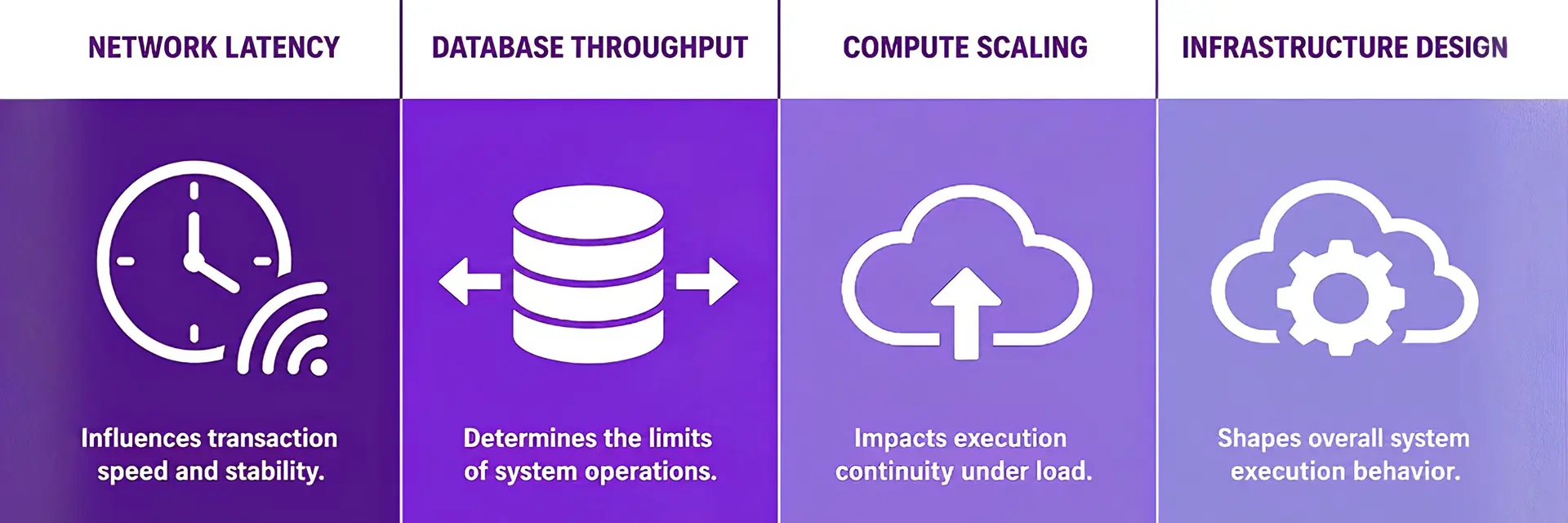
Cloud environments introduce variables that directly influence ERP performance:
- Network latency between services
- Database input/output throughput (IOPS)
- Compute resource allocation and scaling behavior
- Storage architecture and read/write patterns
These variables operate as an interconnected system. Their interaction determines how transactions are processed, validated, and completed.
A financial posting process, for example, may appear simple at the surface. In practice, it involves multiple database reads, cross-module validations, and distributed write operations.
As infrastructure latency increases even marginally each step accumulates delay. At scale, this accumulation becomes visible as system slowdown. So, The application logic remains unchanged. Execution conditions do not.
Latency as an Execution Constraint
Latency is often treated as a technical metric. In cloud ERP environments, it directly influences execution dynamics.
It manifests across three dimensions:
- Transaction Duration
Each incremental delay extends the lifecycle of a transaction. At scale, this affects overall process completion time. - Database Lock Contention
Longer-running transactions hold locks for extended periods, reducing throughput and introducing cascading delays across operations. - Perceived System Reliability
Variability in response times leads users to interpret the system as unstable, even when availability remains intact.
These effects are cumulative. Over time, they redefine how the system is experienced operationally.
Compute Scaling and Execution Stability
Cloud environments provide dynamic scaling capabilities designed to respond to fluctuations in demand.
However, scaling mechanisms operate with a delay. During this interval:
- available resources may remain constrained
- transaction queues may increase
- response times may deteriorate before recovery
In high-volume ERP environments, these intervals affect execution continuity.
In addition, scaling increases capacity without addressing inefficiencies in execution logic. Suboptimal transaction design or database interaction patterns continue to affect performance regardless of resource availability.
The result is an environment that expands under load while exhibiting variability in behavior.
Database Throughput as a Performance Limiter
The database layer establishes the operational limits of any ERP system.
Performance degradation frequently originates from:
- insufficient input/output operations per second (IOPS)
- inefficient query execution plans
- contention across concurrent read/write operations
Even well-structured processes encounter constraints when database throughput does not match transaction demand.
In cloud environments, this condition is often interpreted as an application issue. As a result, organizations attempt to optimize workflows or modify configurations, while the actual limitation remains unresolved at the infrastructure level.
Distributed Architecture and Execution Delay
Cloud deployments frequently distribute system components across multiple zones and services. This improves resilience but introduces separation between system elements.
Each interaction between:
- application and database
- ERP system and integrated services
- user interface and backend processing
is subject to network latency.
Individually, these delays remain minimal. Collectively, they influence execution speed.
In multi-entity environments, where transaction volumes are higher and system interactions more complex, these effects accumulate impacting reporting cycles, approval workflows, and financial closing timelines.
Case Reflection: Infrastructure-Induced Performance Shift
In one enterprise environment, system response times increased by over 40% within six months, despite no significant changes to ERP configuration.
Initial analysis focused on workflow complexity, user behavior, and transaction volume.
A deeper review identified infrastructure-related changes:
- shared storage resources
- increased network distance between application and database
- dynamic compute allocation under fluctuating load
The ERP system continued to operate correctly. However, infrastructure variability altered execution consistency.
After restructuring the infrastructure layer optimizing storage allocation, reducing latency paths, and stabilizing compute resources performance returned to baseline without modifying the application.
Infrastructure as Part of the Execution Architecture
Cloud infrastructure is often treated as a hosting decision. In practice, it operates as part of the execution architecture.
It determines:
- how fast transactions move
- how consistently systems respond
- how reliably processes complete
This aligns with principles outlined in ISO 9001, where process performance depends on the conditions under which execution occurs. In cloud ERP environments, those conditions are defined by infrastructure design.
Strategic Insight: Performance Emerges from Infrastructure Design
At the executive level, performance issues are often addressed through system-level optimization workflow adjustments, configuration changes, or increased automation.
This approach assumes that performance originates within the system.
Cloud environments require a broader perspective.
Performance is influenced by both system design and infrastructure behavior.
Organizations that treat infrastructure as secondary encounter recurring instability despite continuous system refinement.
Those that incorporate infrastructure into execution design achieve:
- consistent transaction behavior
- predictable response times
- stable performance under growth
Related Insights
To deepen the perspective on how system behavior is shaped across enterprise layers:
- Multi-Entity Process Design and Execution Complexity
- Technology Alignment with Operating Model Design
- Governance Sustains System Value in Enterprise Environments
- Execution Excellence and System Performance Dynamics