
The AI Tax in Enterprise ERP: Why Odoo AI Is Reshaping the Cost Logic for UAE Businesses
SAP and Oracle have taken the same approach to AI: build the capability, then license it separately on top of an already substantial subscription. Odoo's approach is structurally different, AI capabilities are embedded in the core platform, not sold as a premium layer. For UAE businesses evaluating ERP investment in 2026, the architectural difference between these two models has a direct financial consequence, and understanding it at the technical level is more useful than reading vendor comparison sheets.
There is a moment most UAE technology leaders recognise: the ERP contract is signed, the implementation is underway, and then the line items for AI features appear separately, at premium rates, on a different billing cycle.
It has a name in the market: the AI tax. It is the structural outcome of how the two dominant legacy ERP vendors have positioned artificial intelligence within their product architecture. AI is not a platform feature in either system. It is an add-on layer, licensed separately, priced at a premium that scales with usage and entity count.
For companies in Dubai and Abu Dhabi accelerating digital transformation under Vision 2031 priorities, this creates a specific problem: the cost of AI capability in enterprise software grows fastest at precisely the scale these companies are trying to achieve.

How the AI Tax Works Architecturally
SAP's AI approach centres on the Business AI framework and Joule copilot. The complication is layering: many capabilities require SAP Business Technology Platform (BTP) as the underlying infrastructure, which carries consumption-based licensing. Activating Joule for specific workflows means activating a separately metered service on a platform that itself requires a separate contract.
Oracle's AI approach follows a similar structure. AI agents and generative features in Oracle Fusion ERP sit within Oracle's AI Services layer — a separate consumption-based product within OCI (Oracle Cloud Infrastructure). Natural language querying for financial reporting requires a procurement step outside the existing ERP contract.
The pattern in both cases: AI capability is real and technically advanced, but the access model is layered. For a mid-size UAE company operating across two or three legal entities, activating AI across core business workflows in either platform produces a pricing structure that was not in the original business case.
How Odoo Embeds AI Differently
Odoo's architecture makes a different product-level decision. AI is not a separate product. It is a platform capability that ships with the subscription and operates across modules without a separate activation fee.
The current Odoo AI layer includes:
Smart document digitisation invoices, vendor bills, and expense receipts processed and mapped to accounting entries automatically, with no third-party OCR fee
Natural language reporting users query operational data conversationally and receive structured report outputs without writing queries
AI-assisted CRM lead scoring, email response suggestions, and opportunity classification within the existing module
Odoo Copilot conversational AI handling cross-module queries, drafting communications, and surfacing data in real time
Predictive inventory stocking recommendations incorporating historical patterns without a separate forecasting module
Every one of these capabilities is available to a standard Odoo subscriber. There is no AI tier, no consumption meter. Adding a new legal entity or new module does not trigger a separate AI licensing calculation.
For UAE businesses in the AED 10M–200M revenue range, the AI tax disappears from the total cost of ownership model entirely.
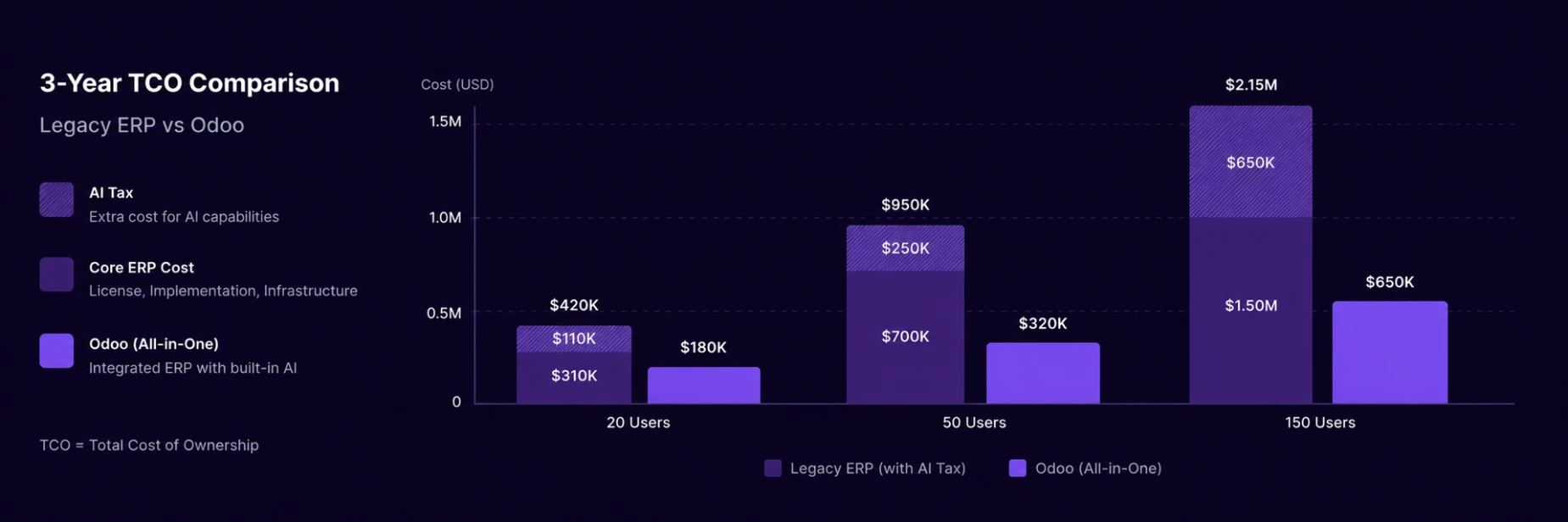
The Cost Architecture in Numbers
A representative UAE mid-market company evaluating ERP in 2026 for 50 users across two legal entities:
Legacy enterprise ERP (SAP or Oracle equivalent tier):
Base ERP subscription: AED 180,000–240,000/year
AI module activation and BTP/OCI layer: AED 60,000–100,000/year additional
Implementation and localisation: AED 250,000–400,000 one-time
Annual maintenance and support: 18–22% of licence value
Total 3-year TCO estimate: AED 1.2M–1.8M
Odoo Enterprise (equivalent scope):
Base subscription (50 users, full module access): AED 90,000–130,000/year
AI features: included in subscription
Implementation and localisation: AED 80,000–150,000 one-time
Annual maintenance: included or low add-on
Total 3-year TCO estimate: AED 450,000–650,000
The 40–60% delta is an architectural outcome. Odoo does not segment AI as a premium product, and the cost structure reflects that decision directly.
Note: Figures are illustrative ranges based on publicly available pricing and market experience. Actual costs vary by scope and contract terms.
What This Means for UAE Businesses
Established enterprises (AED 200M+ revenue, multinational operations) may have structural reasons to maintain SAP or Oracle deployments existing integration landscapes, global parent standardisation, or compliance requirements in non-UAE jurisdictions. The AI tax is real but absorbed within a larger IT budget. The architectural argument for Odoo applies at the module and subsidiary level, not necessarily as a full platform replacement.
Growth-stage and mid-market UAE businesses (AED 5M–200M revenue) face a different calculation. Every dirham allocated to AI licensing premiums in the ERP contract is a dirham unavailable for talent, expansion, or working capital. The digital strategy framework for companies at this stage should treat ERP total cost of ownership as a strategic variable, not a procurement outcome.
For this segment, Odoo's architecture modular, AI-embedded, with UAE VAT, WPS, and e-invoicing compliance built into the core — is not a compromise on capability. It is a different set of architectural decisions that produce significantly lower total cost while delivering AI-native workflows the legacy platforms charge separately to access.
When Odoo Is the Wrong Answer
Complex global manufacturing in aerospace, automotive, or pharmaceutical sectors may require SAP S/4HANA's industry configuration depth 20+ years of accumulated specialisation that Odoo's manufacturing module does not yet replicate.
Organisations with deeply customised SAP or Oracle estates thousands of custom objects, complex intercompany workflows, compliance reporting built on the platform face migration costs that make a full switch economically irrational regardless of the AI tax delta.
Heavily regulated financial institutions under CBUAE or SCA oversight may find legacy platforms' pre-built regulatory reporting libraries justify the premium in compliance risk reduction.
The correct question is which platform's architectural decisions align with the organisation's operational profile and cost tolerance. For the majority of UAE businesses outside these categories, the AI tax is a real and avoidable cost.
Frequently Asked Questions
The AI tax is the additional licensing cost that SAP and Oracle apply to AI features sitting outside the core ERP subscription. Copilots, intelligent document processing, and natural language querying require separate activation on underlying cloud platforms (SAP BTP, Oracle OCI) with consumption-based pricing. The result is AI capability that was not included in the original ERP contract and grows as usage scales.
At the mid-market level, Odoo AI covers the core AI workflows driving operational value: intelligent document processing, natural language reporting, AI-assisted CRM, predictive inventory, and conversational process assistance. SAP Joule and Oracle AI are technically more extensive for complex enterprise-specific processes particularly in large manufacturing and financial services. The question is whether that additional depth is operationally required, or represents capability a mid-market UAE company would never deploy.
Based on publicly available pricing structures, mid-market UAE businesses typically see 40–60% lower three-year total cost of ownership with Odoo. The gap is driven by lower base subscription costs, the absence of a separate AI licensing layer, and significantly lower implementation costs due to standardised UAE VAT, WPS, and e-invoicing localisation.
Odoo's UAE localisation includes VAT-compliant invoicing, WPS-formatted payroll outputs, and the data architecture required for the FTA e-invoicing mandate. AI-assisted features operate within this compliance framework. Organisations should validate specific configurations with a qualified Odoo implementation partner before go-live.
The primary criteria: integration surface complexity, data migration scope, customisation depth requiring rebuild, and whether current platform industry-specific functionality has a direct Odoo equivalent. Businesses where the platform was deployed as a standard implementation with limited customisation typically have higher migration feasibility than heavily customised estates.
Advisory note: Pricing figures are illustrative. Regulatory compliance configurations should be validated with qualified advisors. This post intentionally names SAP and Oracle as an approved editorial exception to SSD4ME's standard house style.
The Strategic Takeaway: Architecture Is the Cost Decision
The AI tax is not a pricing accident. It is the structural outcome of how SAP and Oracle built their platforms AI as an additive, separately monetised capability on top of a core system that predates the AI era. Odoo built differently: a modular platform designed for the current technology cycle, where AI is a default capability embedded in the platform from the start.
For UAE businesses accelerating digital transformation in 2026, the relevant evaluation is not which vendor has the most impressive AI demo. It is which vendor's architectural decisions produce a cost structure, a compliance posture, and a scalability profile that matches the organisation's operational reality.
The AI tax is avoidable. The architecture that avoids it is available. The decision is which one the business is prepared to make.